


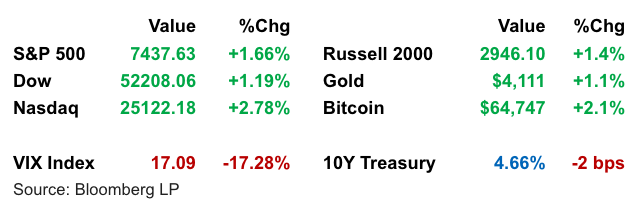
U.S. equities staged a sharp rebound as investors returned to artificial intelligence and semiconductor stocks after a steep selloff following the Federal Reserve’s decision to hold interest rates steady. Strong earnings and cloud growth from Microsoft helped restore confidence in the AI investment theme, offsetting concerns about slower economic growth and elevated inflation. Treasury yields were mixed, the dollar weakened, and risk assets broadly recovered as investors reassessed the outlook for monetary policy and corporate earnings.
Key Headlines & Market Movers:
- AI and Semiconductor Stocks Lead the Recovery: Semiconductor and AI-related stocks posted their strongest advance in more than a year as investors bought into a sector that had recently experienced significant volatility. Microsoft’s earnings-driven surge reinforced optimism around enterprise AI spending and cloud demand, helping lift the broader technology sector. The rebound suggested investors remain willing to support AI-linked companies despite recent concerns about valuations and growth expectations.
- Economic Data Supports a Soft-Landing Narrative: June inflation data largely met expectations, with both headline and core PCE measures showing further moderation from prior readings. At the same time, second-quarter GDP growth slowed relative to expectations, indicating economic momentum is cooling but not collapsing. The combination reinforced the view that inflation is gradually easing while the economy remains resilient enough to avoid a severe downturn.
Earnings and Capital Spending Remain in Focus: Microsoft’s strong results contrasted with Meta’s weaker profitability outlook as rising AI-related expenses weighed on sentiment toward the social media giant. Investors continued to monitor the enormous capital commitments being made across the technology sector, including spending on data centers, cloud infrastructure, and AI development. Attention also shifted toward earnings from Amazon and Apple as markets looked for additional confirmation that technology spending trends remain healthy.
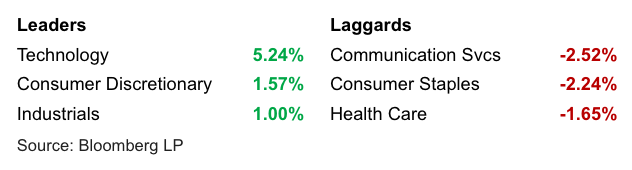
S&P 500 Sector Performance
Looking Ahead
Investors will continue to focus on upcoming earnings reports, the durability of AI-related demand, and whether economic data supports a path toward lower inflation without a significant slowdown in growth. Expectations for future Fed policy remain fluid, with markets reassessing the likelihood of additional rate increases after recent inflation and growth readings. The key question is whether the latest rally represents the resumption of the broader bull market or a short-term recovery following an overstretched selloff.
Disclaimer
Duncan Williams Asset Management is an SEC registered investment adviser. SEC registration does not constitute an endorsement of Duncan Williams Asset Management by the SEC nor does it indicate that Duncan Williams Asset Management has attained a particular level of skill or ability.
This material prepared by Duncan Williams Asset Management is for informational purposes only and is accurate as of the date it was prepared. It is not intended to serve as a substitute for personalized investment advice or as a recommendation or solicitation of any particular security, strategy or investment product. Past performance is not indicative of future results. Investing involves risks, including the risk of loss of principal. Before making any investment decision, investors should consult with their financial advisor, consider their individual financial circumstances, and carefully review all relevant information and risk factors. Duncan Williams Asset Management assumes no responsibility for errors or omissions, nor does it accept liability for any loss arising from reliance on this information.
Advisory services are only offered to clients or prospective clients where Duncan Williams Asset Management and its representatives are properly licensed or exempt from licensure. No advice may be rendered by Duncan Williams Asset Management unless a client service agreement is in place.
This material is not intended to serve as personalized tax, legal and/or investment advice since the availability and effectiveness of any strategy is dependent upon your individual facts and circumstances. Duncan Williams Asset Management is not a legal or accounting firm. Please consult with your legal or tax professional regarding your specific tax situation when determining if any of the mentioned strategies are right for you.

Investment Management Group (IMG)
The Investment Management Group at Duncan Williams Asset Management is led by a team with extensive experience in investment management, financial planning, and client service. President David Scully, CFA®, CFP®, has more than 20 years of experience and is active in Memphis civic organizations. Chief Investment Officer Kyle Gowen, CFA®, CFP®, oversees investment strategy and is engaged with the local community. Investment Analyst Jack Eason, CFA®, provides research and supports charitable initiatives. The IMG team is committed to professional standards, client service, and community involvement. No statement is intended as an offer of investment advice or a guarantee of future results.


Recent Articles


Let's talk about your future.
Connect with a local Duncan Williams Asset Management advisor

5350 Poplar Ave.
Suite 600
Memphis, TN 38119

