

Considering a Safe Harbor 401(k) Design for Next Plan Year: What to Weigh Now
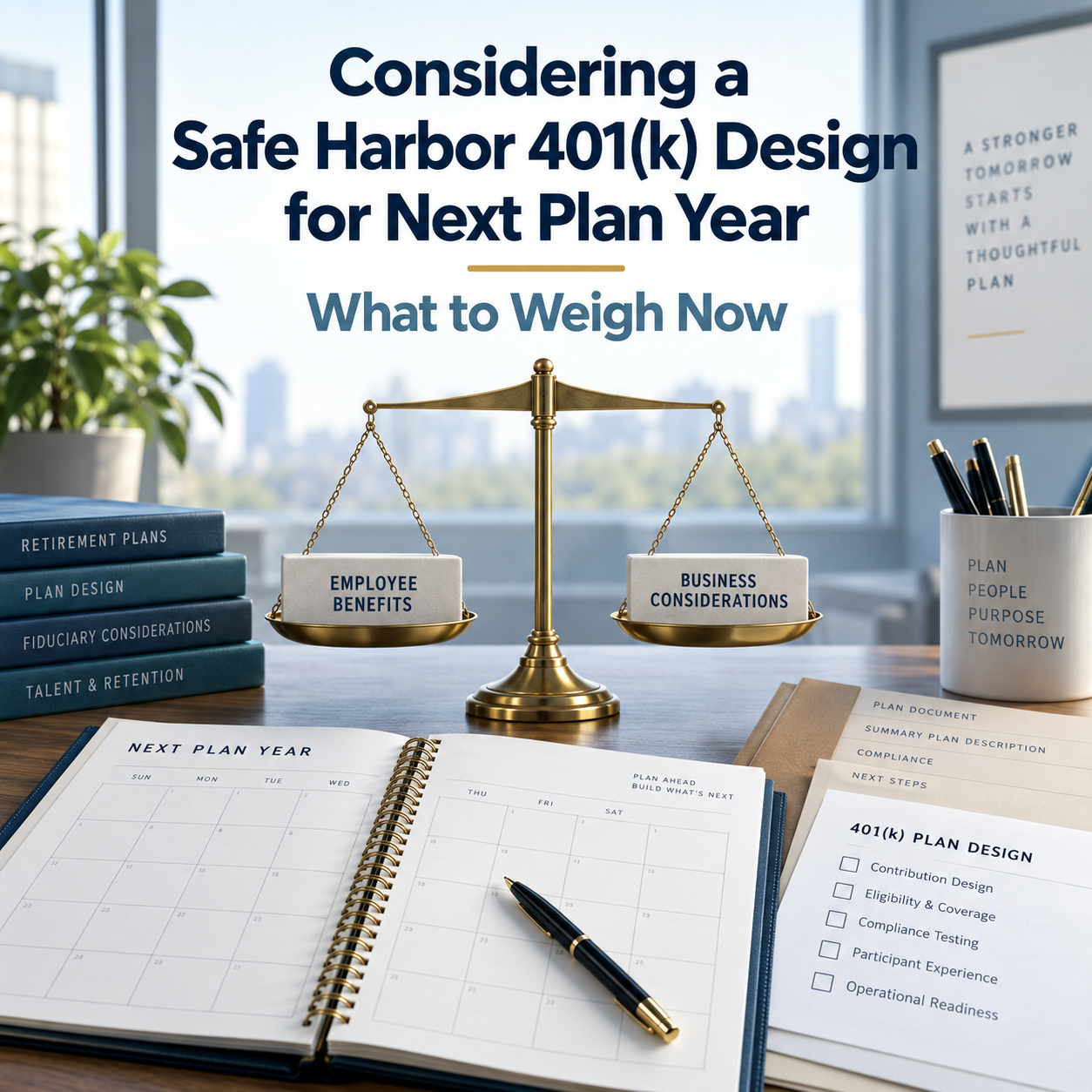
Benefits season is a useful planning window for looking beyond enrollment materials and toward the operating choices that shape next year’s 401(k) plan. For many business owners, safe harbor plan design comes up when annual testing results are hard to predict, leadership wants more certainty around contributions, or the company is revisiting its total-rewards message. A safe harbor design is not a catch-all answer. It is a plan-design framework with contribution, notice, documentation, and timing considerations that you should understand before year-end decisions crowd the calendar.
What “safe harbor” changes in the planning conversation
A traditional 401(k) plan may be subject to annual ADP and ACP nondiscrimination testing. Those tests compare certain employee deferral and matching contribution patterns throughout groups. Safe harbor designs can provide a route around those particular tests when the plan satisfies the applicable requirements. That potential predictability is often the first reason an employer explores the option.
The trade-off is that safe harbor status depends on defined employer-contribution and operational requirements. A company generally needs to decide what contribution formula it can support, how to calculate it, and how to communicate and administer it. The conversation is therefore bigger than “Can testing be avoided?” It includes payroll practices, workforce makeup, budget variability, eligibility, vesting, and whether the formula fits the organization’s broader compensation philosophy.
For example, a company with a stable headcount and recurring annual compensation planning may approach an employer contribution differently than a growing business with uneven hiring, seasonal payroll, or several employee classes. Neither fact pattern automatically points to a particular design. It does suggest bringing assumptions into the review rather than leaving them implicit.
Employer contributions are a design commitment, not just a test result.
Safe harbor arrangements can involve employer contributions made as a match or as a contribution that is not contingent on an employee deferral, subject to the plan’s terms and the applicable rules. When considering alternatives, plan sponsors can ask how each formula would operate across actual payroll cycles and different levels of employee participation.
It can help to model contribution expense using current payroll data and a few reasonable workforce scenarios. The goal is not to forecast a guaranteed cost. It is to understand what inputs drive the estimate: eligible compensation, the population covered, employee deferral behavior, new hires, and the selected formula. A model that uses only a single recent payroll period can miss the practical effect of bonuses, turnover, acquisitions, or seasonal staffing.
Vesting is also part of the discussion. Some safe harbor contributions possess vesting requirements that differ from a company’s approach to other employer contributions. This can affect how the plan’s retention goals, recordkeeping setup, employee communications, and payroll coding fit together. Reviewing the plan document and current operational procedures together can make those relationships easier to see.
Timing and communications deserve early attention.
A safe harbor decision is not simply a payroll setting that can be changed at any point without consequences. The applicable timing, amendment, notice, and operational rules matter, and they can vary by plan feature or contribution type. The right question for a sponsor is often: “What decisions, notices, and system changes must be complete for the next plan year?”
Starting early gives the sponsor time to obtain input from the recordkeeper, third-party administrator, payroll provider, legal counsel, and advisor. It also creates room to recognize inconsistencies. For instance, the compensation definition used for a contribution formula should correspond to how payroll data will be delivered and how the plan document defines compensation. If a company expects a merger, major hiring initiative, or payroll-system change, it should raise those facts during the review.
Employees need clear, timely communications about material plan features, but the sponsor’s first task is to ensure the design is understood and administratively workable. A clean implementation plan can distinguish between a decision that sounds straightforward in a meeting and one that remains understandable after payroll files, notices, and contribution calculations begin.
Questions that can sharpen the choice
A beneficial discussion does not begin with a preferred label. It begins with questions. What testing experience has the plan had in recent years? What did corrections, refunds, or additional employer contributions require operationally? Which employees are covered by the proposed design? How would the contribution formula interact with compensation practices and bonus timing? Does leadership want a contribution philosophy that is consistent across years, or is flexibility the central concern?
It can also be useful to separate business objectives from technical mechanics. An owner may focus on recruiting, retention, predictability, or maximizing plan contributions inside applicable rules. A service provider can then describe the available designs and how to administer them. That division of labor helps the sponsor retain responsibility for the business decision while relying on qualified professionals for technical interpretation.
A practical process for evaluating safe harbor design
- 1. Gather the current plan record. Assemble the plan document, adoption agreement, recent testing results, contribution reports, payroll definitions, participant census information, and notices. A complete starting file makes it easier for providers to identify available design choices and what would need to change.
- 2. Define the business questions. Identify the outcomes leadership is trying to evaluate—such as testing predictability, recruitment, retention, or budget planning—without assuming that one plan feature resolves every goal. Note expected workforce or compensation changes for the coming year.
- 3. Request comparable design illustrations. Ask the plan administrator and advisor to walk through permitted alternatives using agreed assumptions. Consider how each approach affects employer contributions, vesting, eligibility, notice requirements, testing, and payroll administration.
- 4. Confirm timing and implementation responsibilities. Create a calendar for amendment decisions, required communications, payroll configuration, file testing, and approvals. Assign an owner for each item and document questions that require tax or legal input.
- 5. Record the decision and revisit it periodically. Minutes or a decision memo can capture the information considered, the assumptions used, and the providers consulted. Revisit the design as the company’s workforce and total-rewards priorities evolve.
A safe harbor evaluation is most useful when it becomes part of regular plan governance, not a last-minute response to an unwelcome testing result. With time to compare trade-offs and coordinate service providers, business owners are able to make a better-informed decision about whether the design fits their plan and organization.
Want help evaluating a safe harbor 401(k) design?
Safe harbor design decisions touch contribution budgeting, plan administration, employee communications, and year-end timing. Duncan Williams Asset Management can help you walk through safe harbor plan design, understand the questions to ask your service providers, and pinpoint areas where additional professional input may be useful. To discuss your plan's safe harbor design considerations, call our team at [DWAM phone number] to arrange a conversation about your retirement plan.
Sources & further reading
- • Internal Revenue Service — 401(k) Plan Overview: https://www.irs.gov/retirement-plans/plan-sponsor/401k-plan-overview
- • Internal Revenue Service — Notice Requirement for a Safe Harbor 401(k) or 401(m) Plan: https://www.irs.gov/retirement-plans/notice-requirement-for-a-safe-harbor-401k-or-401m-plan
- • Internal Revenue Service — Operating a 401(k) Plan: https://www.irs.gov/retirement-plans/operating-a-401k-plan
- • Internal Revenue Service — Compensation Definition in Safe Harbor 401(k) Plans: https://www.irs.gov/retirement-plans/compensation-definition-in-safe-harbor-401k-plans
- • U.S. Department of Labor — Automatic Enrollment 401(k) Plans for Small Businesses: https://www.dol.gov/agencies/ebsa/about-ebsa/our-activities/resource-center/publications/automatic-enrollment-401k-plans-for-small-businesses
Disclosure


Recent Articles

Let's talk about your future.
Connect with a local Duncan Williams Asset Management advisor

5350 Poplar Ave.
Suite 600
Memphis, TN 38119

