

Planning for Year-End: Deadlines, Extensions, and Common Filing Pitfalls to Avoid
As another year nears its conclusion, many business owners are focused on sales goals, budgeting, hiring decisions, and preparations for the year ahead. Unfortunately, administrative responsibilities surrounding retirement plans are often pushed to the bottom of the list until a deadline is approaching—or has already passed.
A proactive strategy can help plan sponsors avoid unnecessary stress, reduce the chance of errors, and maintain confidence that their retirement plan remains in good order. Through grasping important deadlines, recognizing common filing mistakes, and working with qualified professionals, employers are able to position themselves for a smoother year-end process.
Why Year-End Preparation Matters
Retirement plans operate under a variety of rules established by the Internal Revenue Service (IRS) and the U.S. Department of Labor (DOL). These requirements affect contributions, participant notices, annual testing, reporting obligations, and recordkeeping practices.
Waiting until the final weeks of the year to handle these responsibilities can increase the chance of errors, missed deadlines, and additional costs.
A year-end review can help employers:
- Verify participant eligibility requirements.
- Confirm employee and employer contribution amounts.
- Review compensation definitions.
- Identify employees approaching age-based contribution thresholds.
- Confirm that participant notices have been distributed appropriately.
- Review plan documents and amendments.
- Verify payroll and recordkeeping procedures.
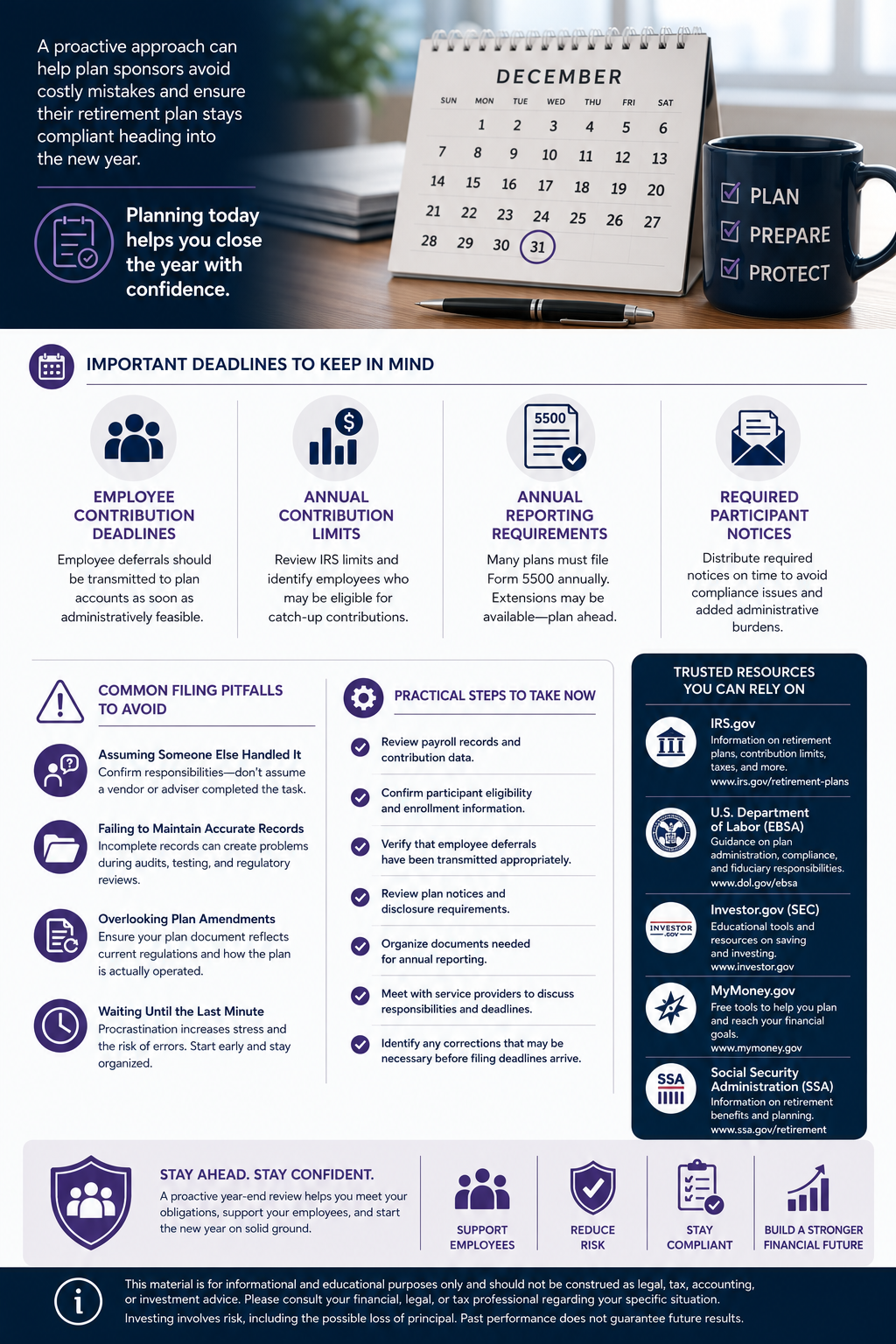
Important Deadlines to Keep in Mind
Every retirement plan is different, but employers should pay close attention to several common milestones.
Employee Contribution Deadlines
Employee salary deferrals should generally be transmitted to plan accounts as soon as administratively feasible. Delays can create compliance concerns and may require corrective action.
Annual Contribution Limits
Employers should review annual IRS limits to ensure participants stay within applicable contribution thresholds and to identify employees who may qualify for catch-up contributions.
Annual Reporting Requirements
Many retirement plans must file Form 5500 annually. Depending on the circumstances, plan sponsors may qualify for filing extensions. Understanding applicable deadlines well in advance can help prevent last-minute complications.
Required Participant Notices
Certain plans require annual notices related to safe harbor provisions, automatic enrollment features, and other plan characteristics. Missing these requirements may create additional administrative obstacles.
Common Filing Pitfalls to Avoid
Even well-managed organizations can encounter problems when responsibilities are divided among multiple service providers. Some of the most common mistakes include the following:
Assuming Someone Else Handled the Task
Employers sometimes believe that a payroll company, third-party administrator, recordkeeper, or adviser has completed a required task when responsibility remains with the plan sponsor.
Failing to Keep Accurate Records
Partial records can create complications in audits, annual testing, and regulatory reviews. Keeping orderly records throughout the year often saves significant time and effort later.
Overlooking Plan Amendments
Retirement plans must evolve as regulations change. Plan sponsors should periodically review governing documents to ensure they reflect both regulatory requirements and actual operating procedures.
Waiting Until the Last Minute
Procrastination can create unnecessary pressure and increase the possibility of errors. Establishing a year-round review process can help reduce bureaucratic burdens and create a more efficient workflow.
Practical Steps Employers Can Take Now
As year-end approaches, employers may want to consider the following actions:
- Review payroll records and contribution data.
- Confirm participant eligibility and enrollment information.
- Verify that employee deferrals have been transmitted appropriately.
- Review plan notices and disclosure requirements.
- Organize documents needed for annual reporting.
- Meet with service providers to discuss responsibilities and deadlines.
- Identify any corrections that may be necessary before filing deadlines arrive.
How DWAM Can Help
Managing a retirement plan involves far more than selecting investment options. Plan sponsors commonly encounter a complex set of regulatory, administrative, and fiduciary responsibilities throughout the year.
Duncan Williams Asset Management (DWAM) works with businesses to help simplify plan oversight, improve participant involvement, and support plan sponsors as they manage important decisions and responsibilities. By taking a preemptive approach throughout the year, employers can spend less time reacting to deadlines and more time concentrating on their employees and their business.
Disclosure
This material has been prepared for informational and educational purposes only and should not be construed as legal, tax, accounting, or investment advice. The information contained herein is general in nature and may not apply to all situations. Individuals and businesses should consult their own legal, tax, and financial professionals regarding their specific circumstances.
Investing involves risk, including the possible loss of principal. Past performance does not guarantee future results. Duncan Williams Asset Management is a registered investment adviser. Registration does not imply a certain level of skill or training.
Source URLs
Internal Revenue Service (IRS)
- https://www.irs.gov/retirement-plans
- https://www.irs.gov/retirement-plans/plan-sponsor/401k-plan-fix-it-guide
- https://www.irs.gov/retirement-plans/retirement-plans-faqs-regarding-form-5500
U.S. Department of Labor (DOL)
- https://www.dol.gov/general/topic/retirement
- https://www.dol.gov/agencies/ebsa/employers-and-advisers/plan-administration-and-compliance
- https://www.dol.gov/agencies/ebsa
U.S. Securities and Exchange Commission (SEC)
Social Security Administration (SSA)


Recent Articles


Let's talk about your future.
Connect with a local Duncan Williams Asset Management advisor

5350 Poplar Ave.
Suite 600
Memphis, TN 38119

