

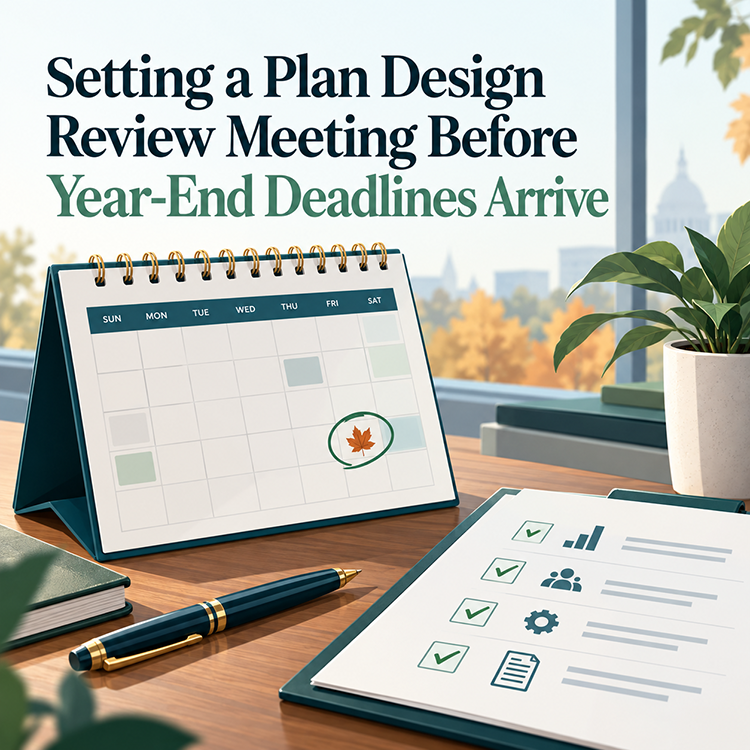
A plan design review meeting is one of the simplest governance habits a business owner can establish before year-end. It creates dedicated time to look at the 401(k) as part of the company’s total-rewards program rather than as a set of isolated administrative tasks. The purpose is not to force a redesign every year. It is to determine whether the current plan still fits the organization’s goals, whether forthcoming deadlines require action, and whether service providers have the information they need to support a well-documented decision process.
Why the calendar matters
Many plan decisions have lead times. A change may require an amendment, provider review, payroll configuration, participant communications, or additional testing before it takes effect. Waiting until the final weeks of the year can narrow choices and put pressure on the people responsible for payroll, HR, benefits, and recordkeeping.
Meeting before deadlines arrive gives leadership a wider view. The group can review the current plan year, identify items that must be completed before year-end, and decide which ideas belong on a next-year project list. This distinction is useful. Some items are time-sensitive compliance or operational tasks; others are strategic alternatives that need analysis before they become decisions.
For example, safe harbor provisions, employer contribution formulas, automatic features, eligibility rules, and vesting can each involve different timing and documentation questions. The sponsor does not need to resolve every issue in one meeting. A well-run review identifies the questions, asks the right provider to address each one, and sets a calendar for follow-up.
Bring the right information, not just a wish list.
The best preparation is accurate. Before the meeting, the sponsor can request recent testing results, plan utilization or participation reports if available, employer contribution information, payroll and census exception reports, current plan documents and amendments, notices, service-provider reports, and a list of known operational issues. The objective is to create a shared baseline.
Commercial context belongs in the file as well. Planned hiring, turnover, compensation changes, bonus practices, acquisitions, layoffs, new locations, and payroll-system changes can all affect plan administration. A benefits strategy conversation is more useful when these facts surface early rather than after a design is chosen.
Circulating a short agenda and questions in advance can help. Participants may include the business owner or plan committee members, HR, payroll, finance, the recordkeeper, the third-party administrator, the advisor, and legal counsel, as appropriate. Each has a different perspective. The sponsor’s role is to ensure that no single provider’s report is mistaken for the complete governance record.
Separate design questions from operations questions
A design review should distinguish between “Should we consider changing this feature?” and “Are we operating the existing feature correctly?” Both questions matter, but they require different evidence and follow-up. A company may decide its current eligibility, matching, or vesting provision is still appropriate while discovering that an onboarding step needs correction. That is a meaningful outcome.
Similarly, a sponsor can discuss whether a safe harbor design or automatic feature merits further evaluation without treating it as a commitment. Asking for illustrations, timing requirements, and implementation responsibilities is part of due diligence. It helps management understand the trade-offs before asking for a formal amendment or system change.
A simple decision log can improve the meeting. For each topic, record the question, information reviewed, provider input, action owner, due date, and whether a decision was made. This helps the organization avoid unclear handoffs and gives the next review a starting point.
Make provider coordination explicit.
Plan administration rarely lives in one system. HR may maintain employee status, payroll processes compensation and deductions, a recordkeeper holds account records, and a third-party administrator performs testing or document support. When you consider a design change, these parties may need different information and lead time.
The sponsor can ask every provider to explain its role in writing. Who drafts or reviews amendments? Who configures eligibility? Who transmits payroll changes? Who prepares notices? Who confirms that the first payroll is handled properly? Who escalates a discrepancy? These questions are practical controls, not unnecessary bureaucracy.
Suppose the company is considering several changes; sequencing matters. It may be more manageable to address a document update and a payroll transition in different windows than to launch everything at once. A review meeting can be where management decides which to prioritize and what to defer to a future cycle.
Let the meeting produce a calendar, not just discussion.
The clearest sign of a productive review is a calendar that survives the meeting. It can list design deadlines, data requests, implementation milestones, communications, and the names of internal and external owners. Reviewing that calendar throughout the year makes the process more durable than relying on a single annual conversation.
A practical process for holding a plan design review meeting
- 1. Set the meeting early and name a sponsor. Schedule the review far enough ahead of year-end to allow for analysis and provider lead times. Identify a plan sponsor representative or committee member responsible for the agenda and follow-up.
- 2. Assemble a concise review packet. Include current plan documents, recent administrative and testing reports, contribution information, notices, known issues, service-provider contacts, and relevant business changes. Provide the packet in advance when possible.
- 3. Use a structured agenda. Cover current operations, testing and plan administration, plan-design features, service-provider responsibilities, forthcoming deadlines, and employee communications. Leave technical interpretations to qualified providers.
- 4. Turn discussion into assigned actions. Document questions, decisions, owners, dependencies, and due dates. Request written confirmation of technical requirements and timing from the appropriate administrator, recordkeeper, payroll provider, or counsel.
- 5. Hold a follow-up check. Before each deadline, review the action log, implementation status, and open exceptions. Retain meeting notes and supporting materials as part of the plan’s governance record.
A thoughtful plan design review is not about making change for its own sake. It is about creating a repeatable decision process which respects year-end timing, connects the 401(k) to the company’s benefits objectives, and keeps operational responsibilities visible throughout the year.
Want help setting up a plan design review meeting?
A timely review can organize next-year design questions, provider responsibilities, and year-end deadlines in one process. Duncan Williams Asset Management can help you walk through plan design review priorities, understand the questions to ask your service providers, and recognize areas where additional professional input may be useful. To discuss your plan's design review process, call our team at [DWAM phone number] to arrange a conversation about your retirement plan.
Sources & further reading
- • Internal Revenue Service — Operating a 401(k) Plan: https://www.irs.gov/retirement-plans/operating-a-401k-plan
- • Internal Revenue Service — 401(k) Plan Overview: https://www.irs.gov/retirement-plans/plan-sponsor/401k-plan-overview
- • Internal Revenue Service — Notice Requirement for a Safe Harbor 401(k) or 401(m) Plan: https://www.irs.gov/retirement-plans/notice-requirement-for-a-safe-harbor-401k-or-401m-plan
- • Internal Revenue Service — Retirement Topics: Automatic Enrollment: https://www.irs.gov/retirement-plans/plan-participant-employee/retirement-topics-automatic-enrollment
- • Internal Revenue Service — Retirement Topics: Vesting: https://www.irs.gov/retirement-plans/plan-participant-employee/retirement-topics-vesting
- • Internal Revenue Service — Compensation Definition in Safe Harbor 401(k) Plans: https://www.irs.gov/retirement-plans/compensation-definition-in-safe-harbor-401k-plans
Disclosure


Recent Articles

Let's talk about your future.
Connect with a local Duncan Williams Asset Management advisor

5350 Poplar Ave.
Suite 600
Memphis, TN 38119

