

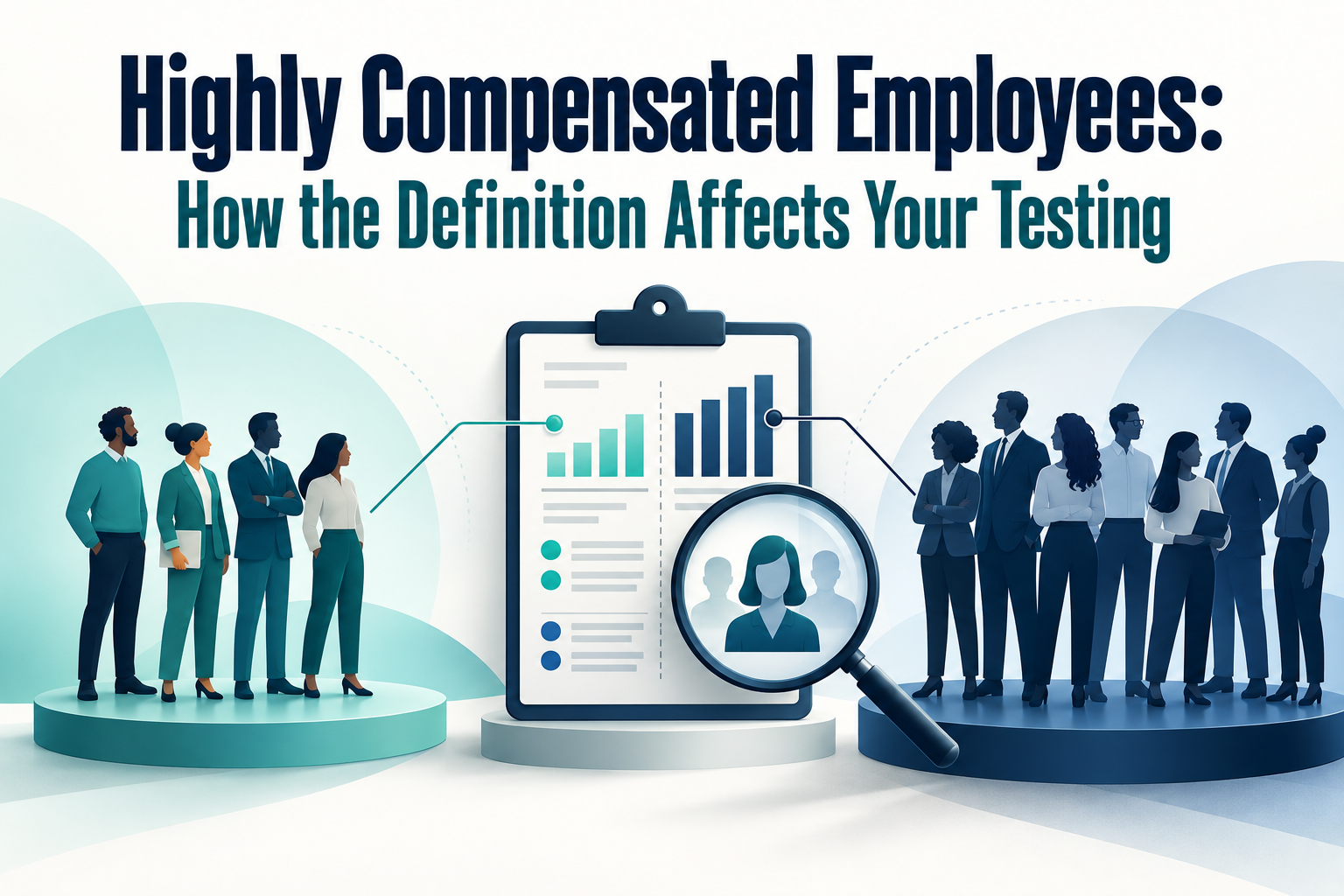
During October’s compliance-testing focus, the definition of a highly compensated employee is an important item for business owners to understand at a high level. The classification can affect how certain testing analyses are organized, so a consistent process for confirming ownership and compensation information can make later testing conversations clearer and less disruptive.
A classification with practical consequences
A highly compensated employee (HCE) is a plan-administration classification rather than a job title or performance label. The plan’s testing process may compare the deferral and contribution patterns of one group with those of other eligible employees. That makes correct classification an input to the testing process, not an optional administrative detail.
For an owner, the useful question is not simply who earns the most. The classification can involve compensation and ownership-related rules, as well as applicable plan provisions. A person’s status could not align neatly with how the organization describes seniority, leadership, or pay bands. Asking the administrator to explain the applicable definition helps prevent internal labels from replacing plan-testing data.
Ownership information deserves a deliberate review.
Ownership can add complexity because family attribution and related-business considerations may affect the data to consider. A sponsor should not assume that a payroll list alone settles the question. Changes in ownership, entity structure, or family relationships may be relevant facts for the plan’s professional advisors to evaluate.
A practical file can list who is responsible for supplying ownership information, when it is confirmed, and what changes occurred during the year. This is especially helpful where a business has multiple entities, has completed a transaction, or has introduced new equity arrangements. Clear documentation allows a plan professional to apply the appropriate rules without reconstructing facts at year-end.
Compensation must match the plan’s process.
Compensation data is another common source of questions. The payroll totals used for internal compensation planning may not be the same data set used in retirement-plan administration. Different payroll codes, bonus timing, and plan definitions may require review. The sponsor’s role is to ensure the administrative team has complete, timely information, not to make technical determinations alone.
It can be helpful to ask how the administrator receives compensation data and whether the file includes all items needed for the intended testing calculation. If unusual payments or payroll conversions occur during the year, flagging them early gives the payroll and administration teams time to align records and ask follow-up questions.
Communicate carefully inside the business.
Because the term includes the word “compensated,” sponsors may be tempted to treat the classification as an employee-relations issue. It is generally more useful to maintain the conversation grounded in plan administration. The purpose is to apply the plan’s testing procedures consistently, not to characterize the value of any employee’s work or benefits.
A sponsor can protect that focus by limiting access to sensitive payroll and ownership information, using established service-provider channels, and documenting the classification review. That approach supports confidentiality while giving the governing team evidence that it asked the right operational questions.
Questions to carry into the next review
The most useful follow-up to a discussion of highly compensated employees: how the definition affects your testing is a short, repeatable set of questions. What facts changed during the year? Which data sources did the team rely on? Who confirmed the information, and where is the final record kept? These questions are intentionally practical. They help a sponsor distinguish between an issue that needs immediate professional attention and a process item to improve before the next annual cycle.
It can be helpful to include the people closest to the work without expanding sensitive information unnecessarily. Payroll can explain how compensation and elections are processed, human resources can confirm employment events and eligibility records, and the plan administrator can explain the effect of those facts under the document and applicable requirements. The business owner or committee can then focus on oversight: confirming that questions were answered, decisions were documented, and responsibilities were assigned.
Finally, keep the review proportionate. A concise meeting note, the reports considered, and a clear list of follow-up items are often more useful than an informal exchange that cannot be reconstructed later. This approach does not guarantee a particular result, and it does not replace legal, tax, or administrative advice. It does create a dependable governance habit: identify the question, obtain appropriate input, carry out agreed actions, and check the process again as the plan and business evolve.
The same discipline can make service-provider conversations more efficient. Sending a short agenda and relevant records before a meeting gives the administrator or advisor a chance to identify missing facts and prepare a focused explanation. Afterward, the sponsor can circulate only the tasks that each internal owner needs to complete. This keeps plan governance connected to everyday business operations while respecting the dedicated roles of payroll, legal, tax, and retirement-plan professionals. Over time, this record of questions and finished tasks can be a useful reference when the business experiences a staffing change, a new provider relationship, or another event that affects plan administration. Consistently applying this approach can also make annual reviews calmer, more focused, and easier to document. It gives the sponsor a practical reference point for confirming that administrative commitments, provider requests, and internal approvals continue aligned throughout the plan year.
A practical process for plan sponsors
- 1. Ask the plan administrator for the current-year list of individuals being treated as highly compensated and the basic data categories used to prepare it.
- 2. Confirm the ownership and business-structure information needed for the review. Route questions involving attribution, transactions, or related entities to qualified legal and plan professionals.
- 3. Reconcile the compensation file to the payroll source and identify unusual payments, late adjustments, or employee-status changes that may require explanation.
- 4. Record the date of the review, the information provided, and outstanding questions. Revisit the list when final year-end payroll information is available.
HCE classification is one of many inputs that support a sound testing process. A consistent annual review can help sponsors preserve data quality, coordinate the right people, and keep decisions connected to the plan document and professional guidance instead of informal assumptions.
Want help evaluating how employee classifications affect testing?
Duncan Williams Asset Management can help you frame the information-gathering process and coordinate questions for your service providers. Duncan Williams Asset Management can help you walk through highly compensated employee classifications, understand the questions to ask your service providers, and pinpoint areas where additional professional input may be useful. To discuss your plan's testing data process, call our team at 901.435.4250 to arrange a conversation about your retirement plan.
Sources & further reading
- • Internal Revenue Service — 401(k) Plan Fix-It Guide: ADP and ACP Nondiscrimination Tests: https://www.irs.gov/retirement-plans/401k-plan-fix-it-guide-the-plan-failed-the-401k-adp-and-acp-nondiscrimination-tests
- • Internal Revenue Service — Is My 401(k) Top-Heavy?: https://www.irs.gov/retirement-plans/is-my-401k-top-heavy
- • Internal Revenue Service — Fixing Common Plan Mistakes: Top-Heavy Errors: https://www.irs.gov/retirement-plans/fixing-common-plan-mistakes-top-heavy-errors-in-defined-contribution-plans
- • Internal Revenue Service — Retirement Plan Correction Program FAQs: https://www.irs.gov/retirement-plans/retirement-plans-faqs-regarding-governmental-plans-and-epcrs
Disclosure


Recent Articles

%20Review%20Before%20Q4.png)
Let's talk about your future.
Connect with a local Duncan Williams Asset Management advisor

5350 Poplar Ave.
Suite 600
Memphis, TN 38119

