

Is Your 401(k) Investment Menu Still Diversified Enough for an Unstable Market?
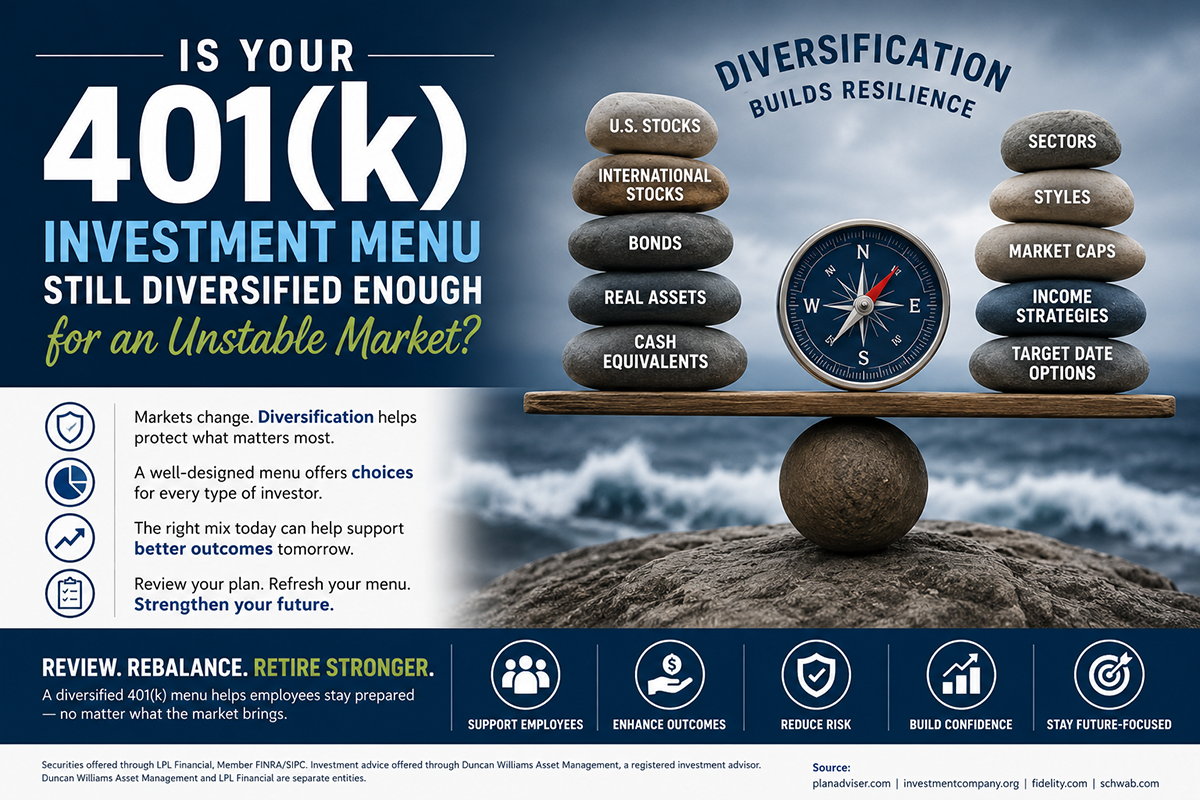
Volatile markets often prompt a broad question from business owners: Is our 401(k) investment menu still appropriately diversified? The question is reasonable, but it deserves more than a reaction to recent performance. A sponsor’s role is to oversee a prudent menu-design and monitoring process, not to forecast sectors or direct individual investment decisions. A structured review can help the committee assess the lineup’s purpose, range, and ongoing fit.
What the committee is actually overseeing
Diversification is a menu-level consideration. A lineup generally provides different investment approaches so participants can choose within the plan or use an available default framework. The committee’s task is not to make every option move differently at every moment. It is to understand the role each option is intended to play and whether the menu is coherent and understandable.
The committee’s responsibility is to evaluate the plan-level framework, not to make account-level decisions for individual participants. It can be helpful to use the plan’s governing documents and regular reporting as a common reference point. That makes it easier to identify the facts that matter, keep the discussion within the committee’s role, and avoid letting a general market narrative become the only basis for action.
Build the review around relevant facts.
A current lineup report can identify each option’s role, category, fees, and material changes. The committee can compare that information with the plan’s IPS or stated design approach and ask whether categories are represented without excess overlap. It can also consider whether descriptions and participant-facing materials still correspond to the choices offered.
A useful review does not require the committee to conclude as soon as a question is raised. Members can identify what is known, what is missing, and which provider or qualified professional is best positioned to supply context. This creates a record of thoughtful inquiry and gives the group a clearer basis for any later decision, rather than relying on assumptions or disconnected data.
Consider the trade-offs before concluding.
A streamlined menu and a wider menu can each raise different governance questions. Neither should be treated as automatically correct without considering the plan’s objectives, population, service model, and administrative capacity. Recent returns are not a substitute for understanding whether two options serve substantially the same function or whether a change has altered an option’s role.
The goal is not to produce a predetermined answer. It is to weigh the relevant information in a manner that is consistent with the plan’s process and proportionate to the issue. A committee may reasonably determine that more information, a later review date, or further monitoring is appropriate, provided that the discussion and follow-through are clear.
Coordinate responsibilities and document follow-through.
For plans using a QDIA, the default is an important part of menu oversight because it may receive contributions when no affirmative election is made. A committee can review how it fits with the lineup and whether notices and administration are being handled. If a possible change emerges, providers can explain mapping, communication, platform, and timing implications before a decision is reached.
Written roles and reliable follow-up help convert a good conversation into governance practice. When the committee identifies an owner, a timing expectation, and the records to retain, provider responsibilities are easier to track. This continuity may be especially valuable when committee membership changes or a later review needs to understand the context of an earlier discussion.
Questions to keep on the agenda
A menu review can also include usability. Are the options and their roles described clearly enough for the plan’s available education tools? Is the default framework understandable to the committee? Do administrative reports accurately reflect the choices available on the recordkeeper platform? These are not individual allocation questions. They are operational and governance questions that help the committee understand whether the menu it monitors is functioning as designed.
A sound review of the plan’s investment lineup usually benefits from a shared set of materials and a clear distinction between information, judgment, and implementation. Information may come from monitoring reports, provider notices, committee records, or plan documents. Judgment is the committee’s consideration of that information under its established responsibilities. Implementation concerns who will complete a follow-up, what communication or administrative work may be required, and when the committee expects confirmation. Keeping these pieces separate can make the discussion easier to follow and the minutes more useful.
Committee members can also ask whether the information they receive is sufficient for the decision before them. A concise report that identifies a change, its context, the potential plan impact, and outstanding questions is often more useful than a large packet without a clear purpose. If more information is needed, the committee can request it and defer a conclusion until a later meeting. Deferral is not a failure when it is accompanied by a defined question, a responsible owner, and a return date.
This approach supports continuity. When a new committee member, HR leader, or provider reviews the file later, they can see what prompted the discussion and how the group moved from information to follow-through. It additionally reinforces an important boundary: plan sponsors oversee the plan’s framework and processes, while individuals make their own account decisions within the plan’s available resources. In this way, regular review supports both responsibility and a more orderly committee experience when questions surface unexpectedly. It gives the committee a repeatable method for separating a question that needs action from one that needs context.
A practical process for the committee
- 1. Obtain a current lineup report showing each option’s role, category, fees, and material changes; request a clear category map from the provider.
- 2. Compare the report with the plan’s documented menu-design approach and list questions about gaps, duplication, the QDIA, or participant materials.
- 3. Discuss the questions with the committee and providers, requesting further information before deciding whether a change, watchlist review, or continued oversight is appropriate.
- 4. Document the review, considerations, and follow-up actions, even if the committee determines that no alteration is warranted.
Building a durable governance habit
A diversified menu is not a promise about market behavior. It is part of a plan structure that deserves consistent oversight. Focusing on option roles, the default arrangement, and the committee’s established process keeps volatility from becoming the only lens for lineup review.
Want help reviewing your plan’s investment menu during an unstable market?
DWAM can help you organize the review, clarify the questions to ask your service providers, and pinpoint areas where additional professional input may be useful. Duncan Williams Asset Management can help you walk through your plan’s investment lineup, understand the questions to ask your service providers, and pinpoint areas where additional professional input may be useful. To discuss your plan’s investment lineup, call our team at 901.435.4250 to arrange a conversation about your retirement plan.
Sources & further reading
• U.S. Department of Labor — Default Investment Alternatives Under Participant-Directed Plans (QDIA): https://www.dol.gov/agencies/ebsa/about-ebsa/our-activities/resource-center/fact-sheets/default-investment-alternatives-under-participant-directed-individual-account-plans
• U.S. Department of Labor — Target Date Retirement Funds: Tips for ERISA Plan Fiduciaries: https://www.dol.gov/agencies/ebsa/about-ebsa/our-activities/resource-center/fact-sheets/target-date-retirement-funds-tips-for-erisa-plan-fiduciaries
• Internal Revenue Service — 401(k) Plan Overview: https://www.irs.gov/retirement-plans/plan-sponsor/401k-plan-overview
• U.S. Department of Labor — Meeting Your Fiduciary Responsibilities: https://www.dol.gov/agencies/ebsa/about-ebsa/our-activities/resource-center/publications/meeting-your-fiduciary-responsibilities
• Internal Revenue Service — Maintaining Your Retirement Plan Records: https://www.irs.gov/retirement-plans/maintaining-your-retirement-plan-records
Disclosure
This material is provided for educational and informational purposes only and does not constitute investment, tax, or legal advice. It is not intended to be, and should not be construed as, a recommendation to adopt any specific plan design, investment, or strategy. The information here is general in nature and may not reflect the current rules or guidance applicable to your specific situation. Business owners and plan sponsors should consult with their own qualified tax advisors, legal counsel, and retirement plan professionals before making any decisions related to their 401(k) or other retirement plans.
Duncan Williams Asset Management is an SEC registered investment adviser. SEC registration does not constitute an endorsement of Duncan Williams Asset Management by the SEC nor does it indicate that Duncan Williams Asset Management has attained a particular level of skill or ability.


Recent Articles


%20Review%20Before%20Q4.png)
Let's talk about your future.
Connect with a local Duncan Williams Asset Management advisor

5350 Poplar Ave.
Suite 600
Memphis, TN 38119

