

Strait of Hormuz on Fire: How Iran’s War Is Driving Up Energy Costs in Memphis and Across America
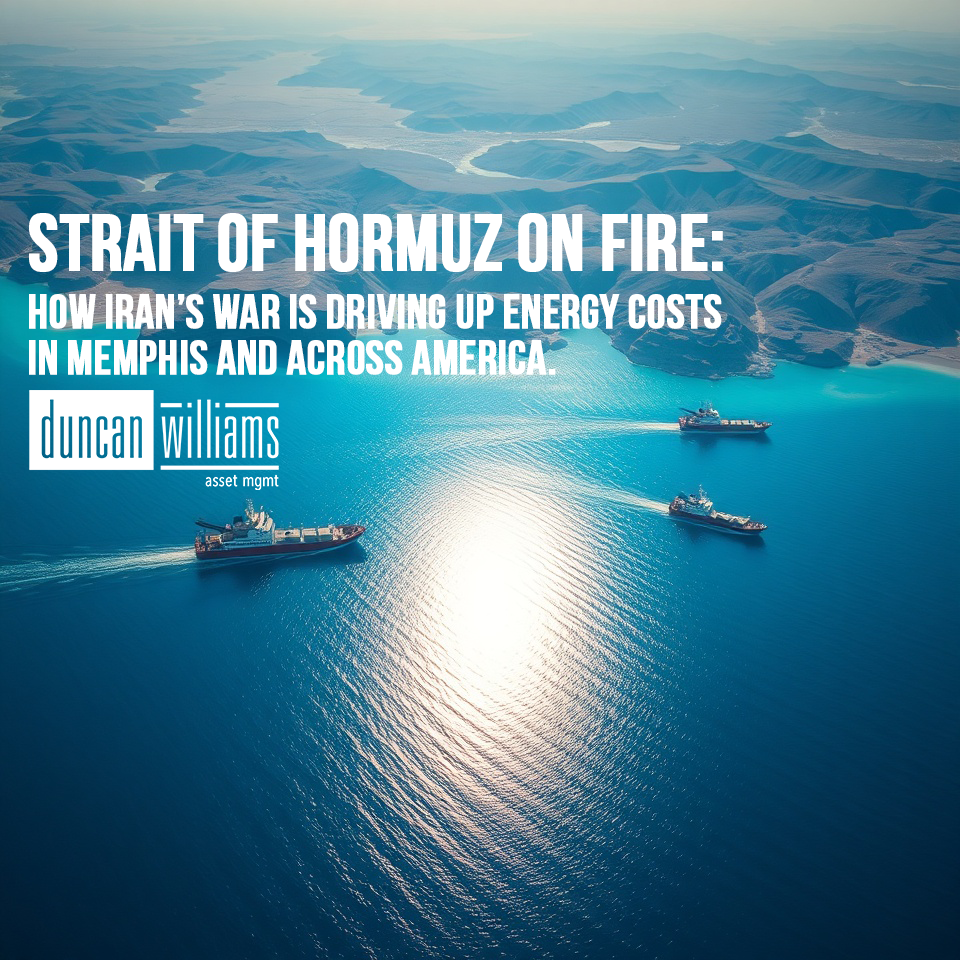
The Strait of Hormuz is the world’s most important oil chokepoint. In the current war with Iran, it has become a frontline battlefield. What happens there—tankers under threat, missiles flying, and mines in the water—quickly sends repercussions through global oil and gas prices. Those rising prices eventually show up at gas stations and on energy bills for people in the United States, including right here in Tennessee and Memphis.
The chokepoint at the center of a war
The Strait of Hormuz is a narrow stretch of water between Iran and Oman, connecting the Persian Gulf to the Gulf of Oman and the Arabian Sea. It’s deep and wide enough for the world’s biggest oil tankers, and every day, huge amounts of oil and gas from Saudi Arabia, Iraq, Kuwait, Qatar, and the UAE pass through it on their way to global markets. In 2022, about 21 million barrels of oil moved through Hormuz each day—that’s one-fifth of all the oil the world uses and more than a quarter of the oil shipped by sea anywhere. On top of that, a big chunk of the world’s liquefied natural gas (LNG) travels through this narrow waterway too.
Most of the oil and gas that passes through Hormuz is headed for Asia—places like China, India, South Korea, and Japan. But here’s the thing: because oil and gas prices are set on global markets, any trouble in Hormuz means higher energy costs everywhere, not just for countries that buy directly from the Gulf. Only Saudi Arabia and the UAE have pipelines that can bypass the strait, and even those can’t move nearly enough. So when Hormuz is threatened, the whole world senses it. That’s why it’s often called the world’s most important energy chokepoint.
The 2026 war with Iran and the closure of Hormuz
This vulnerability is exactly what the current war has exposed. The 2026 Strait of Hormuz crisis began when the United States and Israel carried out major strikes against Iran—hitting military sites, missile bases, and nuclear facilities, and killing Iran’s Supreme Leader, Ali Khamenei. Iran struck back, launching missiles and drones at Israeli cities and at U.S. military bases in Gulf states like Qatar, Bahrain, and the UAE. At the same time, Iran’s allies—like Hezbollah—ramped up attacks in the wider region.
At sea, Iran has turned the Strait of Hormuz into a weapon. The Islamic Revolutionary Guard Corps has broadcast warnings, calling the strait “closed” and threatening to attack any ship that tries to pass—including setting tankers on fire. Within days, tanker traffic dropped off sharply as ship captains either waited outside the strait or took alternate routes to avoid the danger. By early March, tracking data showed that only a small trickle of commercial ships were still passing through.
Iranian missiles and navy units have already attacked several tankers in the Gulf, killing at least one crew member and making it clear that Hormuz is now a warzone, not just a shipping lane. Tehran has also hit energy infrastructure in nearby Gulf states—like export terminals and gas facilities that supply oil and LNG to the world. In response, major shipping and energy companies have paused operations or sent their cargoes elsewhere, while U.S. and allied navies have started escorting some tankers with heavy protection.
How does this hit global oil and gas markets
Closing—or even seriously disrupting—a route that carries about 20% of the world’s daily oil supply (plus a big share of natural gas) sends instant reverberations through global markets. Crude oil prices, like the Brent benchmark, have already jumped, and traders are worrying out loud about oil hitting $100 a barrel if the crisis continues. Gas markets are also tightening, with disruptions to Qatari LNG shipments raising global prices and forcing buyers in Europe and Asia to scramble for new supplies.
The U.S. now produces a lot of its own oil and gas, but it isn’t shielded from these global shocks. U.S. oil still trades based on global prices, and U.S. LNG exports are part of the same worldwide market. The war has added a “risk premium” to every barrel and shipment—higher shipping costs, expensive war-risk insurance, and ongoing worry that a missile or mine could shut things down for good. That extra cost is now built into what refineries, utilities, and big companies pay all around the world.
The impact on the United States
Directly, only a tiny share of U.S. crude imports comes through the Strait of Hormuz, since America produces a lot of its own oil and gets plenty from Canada. But indirectly, the impact is huge. Gasoline, diesel, and jet fuel prices are set on the global market, and when trouble in Hormuz pushes up global oil prices, refineries on the U.S. Gulf Coast have to pay more. Those higher costs trickle down through the system—first to wholesalers and retailers, then all the way to the gas pump.
As tensions with Iran have escalated, Americans are already seeing higher fuel prices. Average gasoline and diesel prices are climbing, and airlines and trucking companies are warning about rising operating costs—which will eventually show up in ticket prices and shipping fees. These higher energy costs flow through the whole economy, raising the price of goods that need to be transported and putting even more strain on household budgets, which are already stretched by inflation.
Natural gas markets are feeling the squeeze too. With so much LNG disrupted or at risk, global gas prices have gone up, and buyers are willing to pay more for every shipment. That uncertainty affects how companies invest and what they expect in U.S. gas markets, which could impact what utilities and factories pay in the long run—even though the U.S. is a major gas producer and exporter itself.
Why Tennessee is exposed
Tennessee doesn’t get oil directly from Iran or other Gulf countries, but it’s closely tied to national fuel and power markets, which react quickly to global price swings. Most of the crude and refined fuel that comes to Tennessee travels from the Gulf Coast by pipeline or river barge. When world oil prices go up because of a crisis at Hormuz, the wholesale price of gasoline and diesel headed into Tennessee goes up too.
Tennessee uses more energy than it produces, so it has to take prices set by the wider national market. The state uses a fair share of the country’s gasoline and electricity but doesn’t have much control over price spikes that start with global events like this war with Iran. When those shocks hit, households and businesses in Tennessee feel the pinch almost right away.
Memphis: a local lens on a global chokepoint
Memphis is a perfect example of how a crisis far away can hit close to home. The city is home to Tennessee’s only oil refinery and acts as a major hub where pipelines, railroads, highways, and barges come together to move fuel all over the Mid-South. The refinery gets its supply from the Gulf Coast, and the price of gasoline and diesel in Memphis is tied to Gulf Coast prices—which, in turn, are affected by what happens in places like the Strait of Hormuz.
Memphis is also one of America’s busiest logistics centers—a crossroads for trucks, trains, and planes moving goods nationwide. When diesel and jet fuel prices go up because global oil prices are rising, it costs more to move everything through Memphis. Those costs show up in what local families and businesses pay at the store. On top of that, many Memphis families already spend a big chunk of their income on energy bills. When oil and gas prices spike, it can mean tough choices—sometimes cutting back on food, healthcare, or other essentials just to keep the lights on and the car running.
Recent decisions by the Tennessee Valley Authority to build more gas-fired power plants—including in Memphis—could make this problem worse. It means local power bills will be even more linked to unpredictable gas markets. In a world where chokepoints like Hormuz can become flashpoints overnight, that dependence is a real vulnerability—not just for national policymakers but for Memphis neighborhoods, too.
The bigger lesson
The 2026 war with Iran proves that energy security, foreign policy, and the cost of living at home are all tied together. When Iran shuts down the Strait of Hormuz and threatens any ship that tries to pass, it isn’t just a challenge for the U.S. military—it reaches right into American homes through energy prices. For Tennessee and Memphis, the best way to protect themselves is to cut their exposure to these global price shocks. That means using energy more efficiently, investing in different energy sources, and pursuing policies that make energy more affordable—so the next crisis overseas doesn’t hit as hard at home.
Disclosure
This article is for informational purposes only and is being published by an SEC‑registered investment adviser (“RIA”) as general market commentary. It is not intended as, and should not be construed as, investment, legal, tax, or accounting advice, or as a recommendation to buy, sell, or hold any security, strategy, or investment product. The discussion of the Strait of Hormuz, the current conflict involving Iran, and potential impacts on global oil and gas markets, the United States, Tennessee, and Memphis is illustrative in nature, may be based on third‑party information believed to be reliable but not independently verified, and may not reflect the complete set of risks or developments affecting any particular issuer, sector, or geography.
Any forward‑looking statements or opinions expressed are as of the date of publication, are subject to change without notice, and may not come to pass. Actual outcomes may differ materially from those anticipated due to a variety of factors, including changes in geopolitical conditions, energy supply and demand, regulatory developments, and market behavior. References to specific companies, utilities, regions, or public entities are for illustrative purposes only and do not constitute an endorsement, investment recommendation, or indication that any security of those entities is suitable for any particular investor.
Past performance is not indicative of, and does not guarantee, future results. All investments involve risk, including the possible loss of principal. Investors should not rely solely on this article when making investment decisions and should consult with their own financial, legal, and tax advisers to determine the appropriateness of any investment or strategy in light of their individual circumstances and objectives. Registration of an investment adviser with the SEC does not imply a certain level of skill or training.
Sources
U.S. Energy Information Administration – Strait of Hormuz and world oil transit chokepoints:
https://www.eia.gov/todayinenergy/detail.php?id=61002
https://www.eia.gov/todayinenergy/detail.php?id=42338
https://www.eia.gov/international/analysis/special-topics/World_Oil_Transit_Chokepoints
2026 Strait of Hormuz crisis and Iran conflict background:
https://en.wikipedia.org/wiki/2026_Strait_of_Hormuz_crisis
https://en.wikipedia.org/wiki/2026_Iran%E2%80%93United_States_crisis
https://en.wikipedia.org/wiki/2026_Iran_conflict
https://en.wikipedia.org/wiki/Prelude_to_the_2026_Iran_conflict
Coverage of Iran–U.S. tensions and impact on oil/LNG markets:
https://www.aljazeera.com/news/2026/2/22/iran-us-tensions-what-would-blocking-strait-of-hormuz-mean-for-oil-lng
https://www.timesofisrael.com/strait-of-hormuz-key-oil-route-in-middle-of-iran-crisis/
https://www.reuters.com/world/middle-east/iran-vows-attack-any-ship-trying-pass-through-strait-hormuz-2026-03-02/
https://www.cnbc.com/2026/03/03/why-oil-price-surge-is-limited-after-trump-s-iran-strikes.html
https://www.nytimes.com/2026/03/03/business/energy-environment/oil-natural-gas-iran-israel-united-states.html
https://www.cnbc.com/2026/03/03/middle-east-crisis-iran-us-shipping-oil-tankers-strait-of-hormuz.html
Tennessee and Memphis energy profile and infrastructure:
https://www.energy.gov/sites/prod/files/2016/09/f33/TN_Energy%20Sector%20Risk%20Profile_2.pdf
https://www.ebsco.com/research-starters/power-and-energy/tennessees-energy-production
Memphis energy burdens and TVA gas expansion:
https://www.selc.org/press-release/nearly-half-of-memphis-families-face-high-energy-burdens-according-to-new-report/
https://fromcommonground.com/selc-report/
https://www.psrmemphis.org/steep-utility-costs-plague-memphis-poor/


Recent Articles


Let's talk about your future.
Connect with a local Duncan Williams Asset Management advisor

5350 Poplar Ave.
Suite 600
Memphis, TN 38119

