

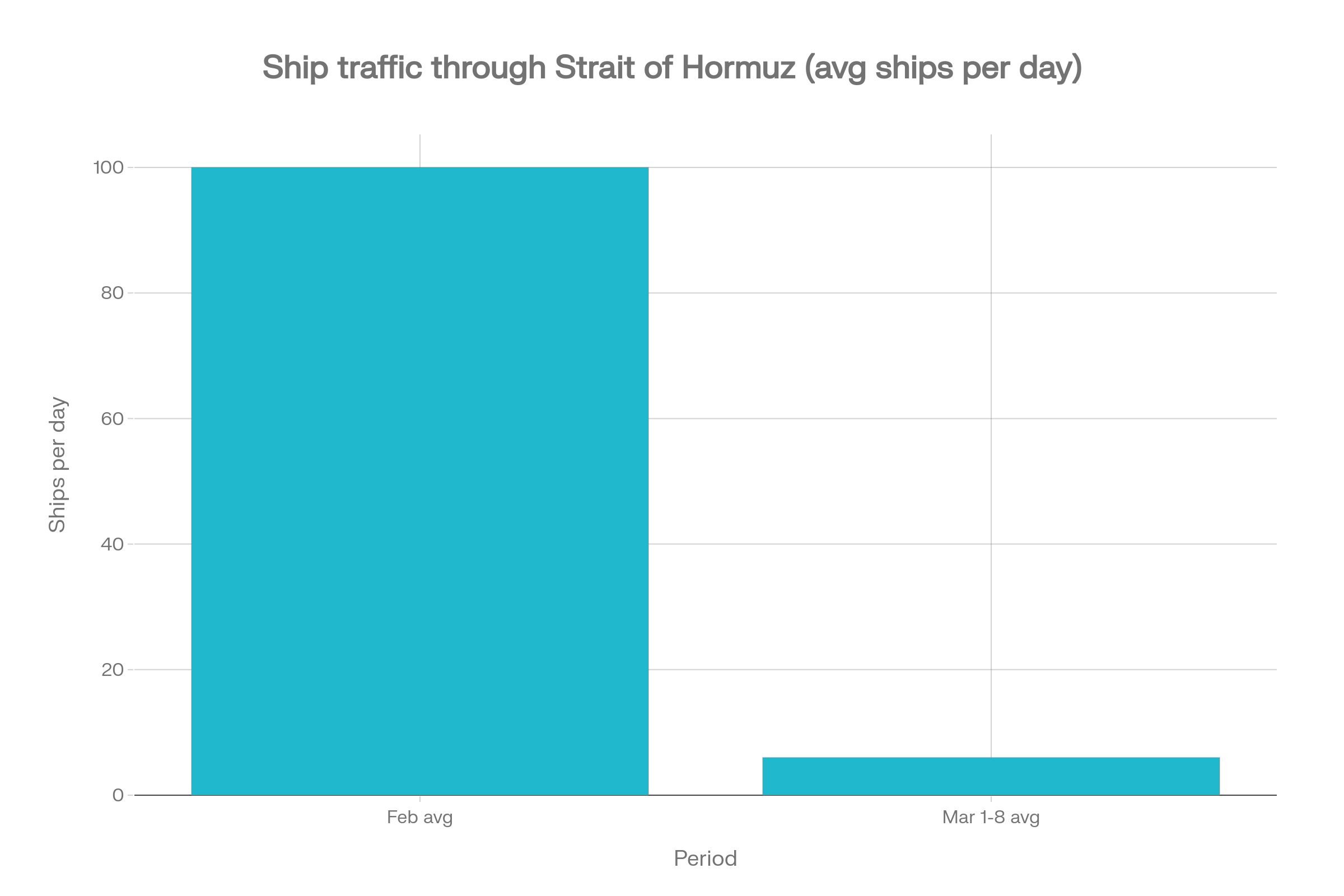
A sudden, dramatic 94% drop in shipping traffic through the world’s most crucial oil chokepoint is sending economic shockwaves well beyond the Middle East. From rising fuel costs to disruptions in farm and logistics operations in West Tennessee, businesses and consumers are already dealing with higher prices and supply chain uncertainties.
What Happened
On February 28, the United States and Israel launched joint military strikes against Iran. In the following days, Iran retaliated by blocking the Strait of Hormuz. This narrow waterway lies between Iran and Oman and is a vital channel for world oil shipping. Roughly 25% of the global maritime oil trade passes through it. IMF PortWatch data shows that average daily ship traffic at the strait dropped sharply. It went from about 100 ships per day in February to just 6 in early March—a 94% collapse.
Between 50% and 60% of vessels passing through the strait are tankers. They carry crude oil and liquefied natural gas. In 2025, the IEA estimated that 20 million barrels per day of crude oil and products were produced in this corridor. Countries such as Iraq, Kuwait, Qatar, and Bahrain depend on the Strait for nearly all their energy exports. The closure made Brent crude surge past $99 per barrel. That’s up from about $60 earlier in the year. In response, the G7 authorized its largest-ever emergency oil reserve release: 400 million barrels.
Pain at the Pump Hits Memphis Hardest in Tennessee
Across Tennessee, the impact is clear at gas stations. As of March 16, the average price statewide is $3.34 per gallon. That’s up 82 cents in just a month, and 63 cents higher than a year ago, according to AAA. Memphis drivers have it even worse. They pay $3.44 per gallon, the highest metro prices in the state, and over 40 cents more than a week ago.
“It’s the uncertainty and volatility in the crude oil market that’s driving prices up here at home,” said Megan Cooper, spokesperson for AAA – The Auto Club Group. “How high prices go depends on how long this conflict with Iran drags on, and whether global fuel supplies take another hit.”
With WTI crude now at $87.25 a barrel and still climbing, both transportation and input costs for local industries are expected to keep rising. If the crisis continues, the cost of goods and services throughout the region will likely increase further.
FedEx Suspends Middle East Services from Memphis Hub
For Memphis, the crisis hits especially close to home. The city is the global headquarters and logistics heart of FedEx. On March 2, FedEx announced it was temporarily halting pickups, deliveries, and flights to and from Bahrain, Iran, Iraq, Israel, Jordan, Kuwait, Lebanon, Oman, Qatar, the UAE, and Saudi Arabia.
The suspended routes make up a significant share of FedEx's international express and freight business. Experts note that rerouting shipments around the conflict zone raises costs. Prolonged disruptions could hurt margins and lead to contractual penalties. The global shipping industry is also affected. Maersk has suspended container services linking the Middle East with Asia and Europe.
Thousands of Memphis-area workers—including pilots, package handlers, support staff, and local vendors—rely on FedEx employment and related contracts. Extended shutdowns of Middle East routes could threaten job security, reduce shifts, or impact local spending, increasing economic uncertainty for the region.
Tennessee Farmers Face a Fertilizer Crisis
The impact extends to rural areas as well—Tennessee’s farmers are also facing financial uncertainty. About a third of the world’s traded fertilizer ingredients, and 40% of all urea (a primary nitrogen fertilizer), are shipped through the Strait of Hormuz. With dozens of fertilizer ships stuck, supply chain disruptions are driving up costs for agricultural operations, threatening farm profitability as spring planting begins.
Todd Littleton, a third-generation farmer in Gibson County, northwest Tennessee, told the Associated Press he expects to pay $100,000 more for fertilizer this season—a 40% jump from last year. “We’ve been hit with several record losses in recent years, so a lot of us are barely hanging on. For input prices to spike again, it really couldn’t come at a worse time,” he said.
The Fertilizer Institute estimates U.S. farmers still need about two million metric tons of urea for spring. Those who did not pre-order may not receive any at all. Fertilizer accounts for about half of a crop’s yield. These shortages may lead to lighter harvests and higher food prices later in the year.
What to Watch
The blockade's duration is now the most important factor. A quick diplomatic deal might let markets stabilize and shipping resume within weeks. But a longer blockade could send oil prices over $100, spike food prices, and push the world toward recession. In Memphis and Tennessee, watch these pressure points:
- ● Gas prices. Memphis already leads the state. Continued crude price increases will raise costs for commuters, delivery drivers, and businesses across the metro area.
- ● FedEx operations. Any extension of the Middle East service suspension would impact Memphis's largest employer and the thousands of local jobs tied to its supply chain.
- ● Farm economy. West Tennessee's corn, soybean, wheat, and cotton farmers face a narrow planting window. Fertilizer shortages now could mean reduced yields and higher food costs by fall.
- ● Consumer prices. Rising diesel costs increase the price of transporting goods to grocery stores and retailers, while higher petroleum prices affect everything from plastics to packaging.
The U.S. will release 172 million barrels from its Strategic Petroleum Reserve over four months. This is part of the larger G7 response. The Trump administration has also signaled plans to boost fertilizer imports from other sources. A $12 billion one-time payment will help farmers offset input costs. Whether these steps work depends heavily on how soon the Strait of Hormuz reopens for trade.
Sources
- IMF PortWatch — Real-time port and maritime trade activity data
https://portwatch.imf.org/ - International Energy Agency (IEA) — Strait of Hormuz oil flow and energy security data
https://www.iea.org/about/oil-security-and-emergency-response/strait-of-hormuz/ - Statista — "Ship Traffic in the Strait of Hormuz Has Virtually Stopped" by Felix Richter, Mar 17, 2026
https://www.statista.com/topics/13645/iran-conflict/ - AAA – The Auto Club Group / Memphis Flyer — Tennessee and Memphis gas price data, Mar 16, 2026
https://www.memphisflyer.com/aaa-memphis-leads-state-gas-price-surge/ - WBBJ TV — Tennessee statewide gas price averages and metro breakdown, Mar 16, 2026
https://www.wbbjtv.com/2026/03/16/tennessee-gas-prices-rise-an-additional-31-cents/ - Memphis Business Journal — FedEx suspends Middle East services, Mar 2, 2026
https://www.bizjournals.com/memphis/news/2026/03/02/fedex-suspends-middle-east-service-changes-war.html - Yahoo Finance / Intellectia.AI — FedEx service disruption analysis and financial impact
https://finance.yahoo.com/news/fedex-disruptions-tariff-ruling-put-011159086.html - U.S. News & World Report / Associated Press — Tennessee farmer Todd Littleton fertilizer cost impact, Mar 18, 2026
https://www.usnews.com/news/best-states/north-dakota/articles/2026-03-18/iran-war-has-us-farmers-worried-about-the-cost-and-availability-of-fertilizer - WUTC / NPR — Fertilizer supply disruption and food price outlook, Mar 16, 2026
https://www.wutc.org/2026-03-16/food-prices-expected-to-rise-as-war-hits-fertilizer-supply - NewsChannel 9 (WTVC) — Strait of Hormuz fertilizer supply threat, Mar 13, 2026
https://newschannel9.com/news/nation-world/strait-of-hormuz-disruption-threatens-fertilizer-supply-raising-crop-yield-price-worry-farm-economy-fertilizer - CGTN — Economic fallout from Strait of Hormuz shutdown, Mar 14, 2026
https://news.cgtn.com/news/2026-03-14/Economic-fallout-unfolds-as-Strait-of-Hormuz-remains-shut-1Lu6M1Z2vO8/index.html - CNBC — Expert oil price scenario analysis, Mar 1, 2026
https://www.cnbc.com/2026/03/01/experts-weigh-potential-scenarios-for-oil-if-strait-of-hormuz-closes.html
Disclosure
This article was prepared for informational purposes only and does not constitute financial, investment, or professional advice. The data, statistics, and quotes referenced were gathered from publicly available news reports and government or institutional sources as of March 18, 2026. Conditions in the Strait of Hormuz, energy markets, and related economic impacts are evolving rapidly, and figures cited may change materially as the situation develops. The author makes no guarantee of the accuracy, completeness, or timeliness of the information presented. Readers should consult qualified professionals before making any financial or business decisions based on the content of this article.


Recent Articles

Let's talk about your future.
Connect with a local Duncan Williams Asset Management advisor

5350 Poplar Ave.
Suite 600
Memphis, TN 38119

