

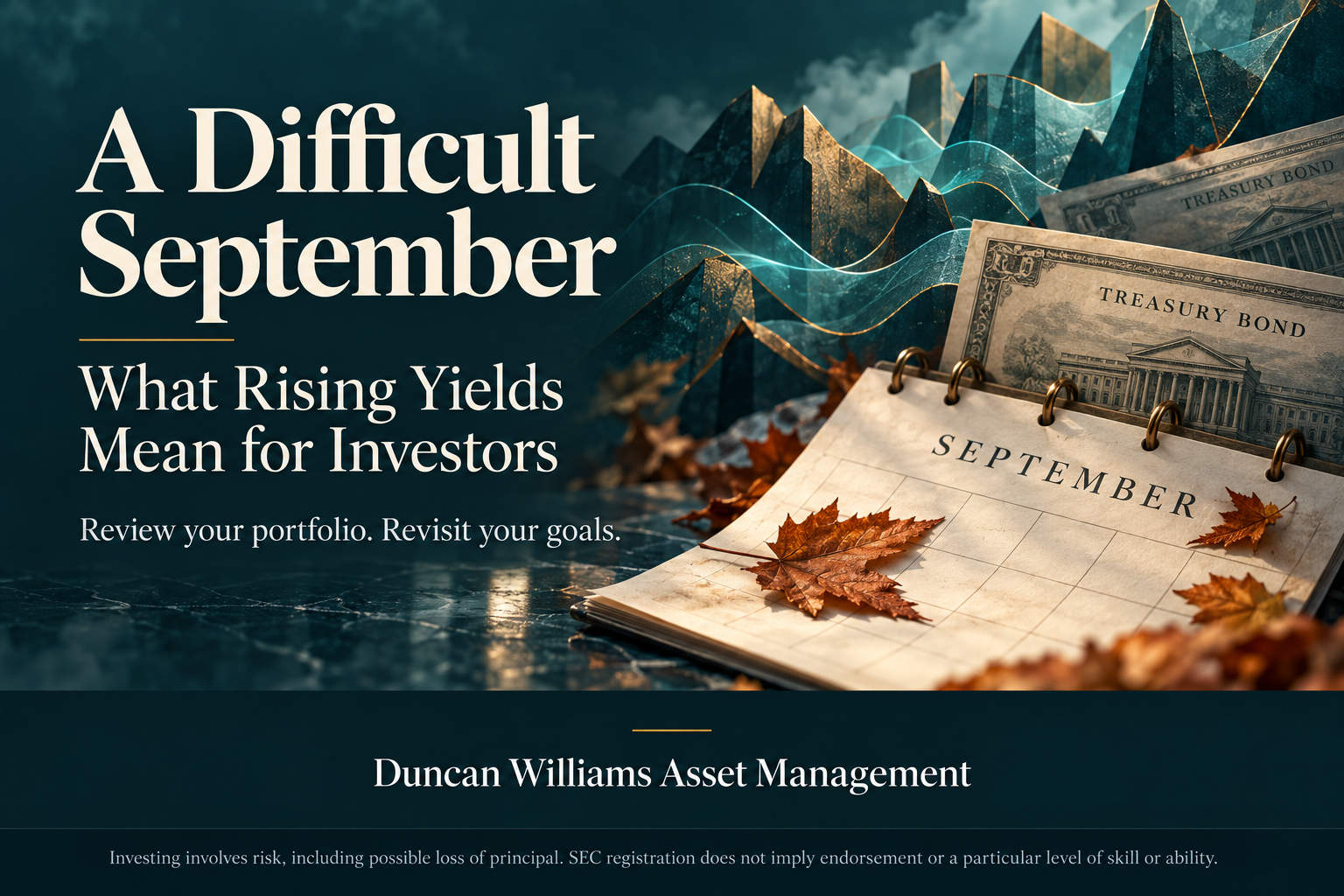
A Difficult September: What Rising Yields Mean for Investors
September ended with a challenging reminder: stocks and bonds can both lose ground when inflation concerns intensify.
Bloomberg’s September 30 briefing reported that global government bonds were closing out their weakest quarter since 2024. The conflict involving Iran and oil prices around $100 a barrel added to concerns about persistent inflation. The U.S. 30-year Treasury yield reached approximately 5.64%, a level last seen in 2002, while the S&P 500 recorded its weakest month since June.
For investors, these developments raise practical questions about portfolio risk, income needs, and the role of fixed income. They also underscore the value of reviewing investment decisions in the context of a financial plan.
Why Bonds Have Been Under Pressure
Bond prices and market interest rates generally move in opposite directions. When newly issued bonds offer higher yields, existing fixed-rate bonds with lower coupons become less attractive, and their market prices typically decline.
Longer-term bonds generally have greater sensitivity to interest-rate changes than otherwise comparable shorter-term bonds. That sensitivity helps explain why a sharp increase in yields can produce substantial price declines, even in U.S. Treasury securities. Government backing does not eliminate the risk of a market loss if a Treasury bond is sold before maturity.
September’s selloff also reflected concerns that elevated energy costs could sustain inflation and keep interest rates higher for longer. Reuters reported that rising energy prices and expectations of economic growth pressured global bonds.
What Higher Yields Change
Higher yields create a tradeoff. Existing bond holdings may decline in price, while money invested at today’s yields may provide more income than comparable investments purchased when yields were lower.
That does not make every bond an appropriate purchase. Investors still need to consider maturity, credit quality, interest-rate sensitivity, taxes, and when they may need access to their money. A quoted yield also should not be confused with a guaranteed total return.
An individual bond held to maturity and a bond fund have different characteristics. An individual bond generally has a scheduled principal repayment, provided the issuer meets its obligations. Most bond funds have no single maturity date at which an investor is assured of receiving the original investment back.
When Stocks and Bonds Decline Together
A portfolio with both stocks and bonds can still lose value. Diversification spreads exposure across investments, but it cannot guarantee a profit or prevent losses during a broad market decline.
The appropriate allocation depends on the investor’s time horizon, financial circumstances, and ability to tolerate risk. September’s experience is a reason to revisit those assumptions and determine whether the portfolio still serves its intended purpose.
For someone approaching retirement, access to funds for near-term spending may deserve particular attention. For someone investing toward a goal decades away, the review may focus more on whether the current allocation remains consistent with long-term objectives.
Questions to Discuss With Your Adviser
A useful portfolio review can begin with four questions:
- Have my needs changed? Consider upcoming withdrawals, major purchases, and changes in household income.
- How much interest-rate risk do I hold? Review the maturity and rate sensitivity of fixed-income investments.
- Does my allocation still match my plan? Market movements may have shifted the balance among asset classes.
- Would an adjustment improve alignment with my goals? Evaluate potential changes alongside transaction costs and tax consequences.
Rebalancing can help restore a portfolio to its intended allocation, but the decision should reflect the investor’s circumstances and the costs of making changes.
How Duncan Williams Asset Management Can Help
Duncan Williams Asset Management can help you work through these questions and assess whether your portfolio remains aligned with your time horizon, income needs, and risk tolerance. That review may include evaluating your bond holdings’ sensitivity to interest rates, identifying investment concentrations, and considering whether rebalancing is appropriate.
For investors approaching or already in retirement, DWAM can help review how upcoming withdrawals fit into the broader investment strategy. For those with longer-term goals, the discussion can focus on maintaining an appropriate allocation while accounting for changes in personal circumstances.
September was uncomfortable for many investors, and the months ahead remain uncertain. A thoughtful response begins with understanding what has changed in the markets, what has changed in your own life, and whether your portfolio still connects the two appropriately.
If recent market movements have raised questions about your investments, contact your DWAM adviser to discuss your portfolio and financial priorities.
Sources
- Bloomberg, “A September to Forget,” September 30, 2026 — publicly accessible reproduction of the briefing.
- Reuters, “Bonds Post Worst Month in Years; Stocks Decline for September and Oil Gains,” September 30, 2026.
- SEC Investor.gov, “Fixed Income Investments: When Interest Rates Go Up, Prices of Fixed-Rate Bonds Fall”.
- SEC Investor.gov, “Asset Allocation and Diversification”.
- SEC Investor.gov, “Beginners’ Guide to Asset Allocation, Diversification, and Rebalancing”.
Important Disclosure
This material is for informational and educational purposes only and does not constitute individualized investment advice or a recommendation to buy or sell any security. Investing involves risk, including the possible loss of principal. Diversification and asset allocation do not guarantee a profit or protect against loss. Bonds are subject to interest-rate, credit, and inflation risks. Past performance does not guarantee future results. Market information reflects reporting through September 30, 2026, and is subject to change. Information obtained from third-party sources is believed to be reliable but is not guaranteed as to accuracy or completeness. Consult your investment adviser regarding your individual circumstances.
Duncan Williams Asset Management is an SEC-registered investment adviser. SEC registration does not constitute an endorsement of Duncan Williams Asset Management by the SEC nor does it indicate that Duncan Williams Asset Management has attained a particular level of skill or ability.


Recent Articles


Let's talk about your future.
Connect with a local Duncan Williams Asset Management advisor

5350 Poplar Ave.
Suite 600
Memphis, TN 38119

