

Documenting Your Process: Why What You Did Matters as Much as What Happened
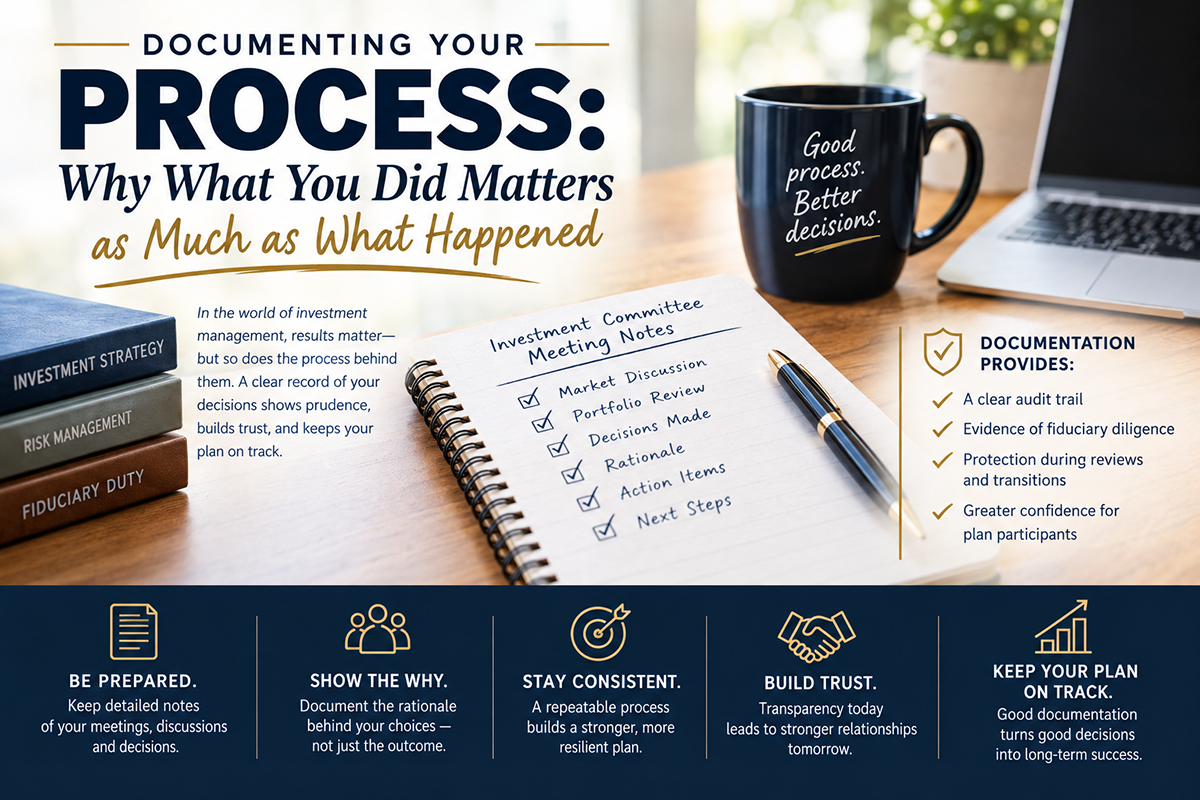
Good retirement-plan governance involves more than reaching a decision. It also involves showing how the committee reached it. For business owners and plan sponsors, documentation bridges an informal conversation and a record of prudent process. This is particularly important in unstable periods, when hindsight can make a reasonable decision appear obvious or questionable depending on what happened afterward.
What the committee is overseeing
Minutes, agendas, meeting materials, provider reports, and follow-up records can show what the committee reviewed, the questions it raised, and the actions it assigned. The goal is not a transcript of every comment. It is a clear account of the matters considered and the basis for the committee’s conclusion, allowing future members to understand why a prior decision was made.
The committee’s responsibility is to evaluate the plan-level framework, not to make account-level decisions for individual participants. It can be helpful to use the plan’s governing documents and regular reporting as a common reference point. That makes it easier to identify the facts that matter, keep the discussion within the committee’s role, and avoid letting a general market narrative become the only basis for action.
Build the review around relevant facts.
A meeting packet and minutes should support each other. The packet may include the agenda, monitoring reports, service information, prior tasks, relevant notices, and communications. Retaining the materials considered gives context but does not crowd minutes with every detail. A consistent file structure also helps a new HR leader locate records without reconstructing history from email threads.
A useful review does not require the committee to conclude as soon as a question is raised. Members can identify what is known, what is missing, and which provider or qualified professional is best positioned to supply context. This creates a record of thoughtful inquiry and gives the group a clearer basis for any later decision, rather than relying on assumptions or discrete data.
Consider the trade-offs before reaching a conclusion.
Committees sometimes document only decisions that change the lineup or plan design. A deliberate decision to maintain monitoring can also reflect a considered process. If the group reviewed volatility, asked questions, and concluded that no change was warranted at that time, the minutes can identify that review and any future check-in point without exaggerating the discussion.
The goal is not to produce a predetermined answer. It is to weigh the relevant information in a manner that is consistent with the plan’s process and proportionate to the issue. A committee may reasonably determine that more information, a later review date, or further monitoring is appropriate, provided that the discussion and follow-through are clear.
Coordinate responsibilities and document follow-through.
Draft minutes are best reviewed while memories are fresh, and follow-up items need named owners and practical dates. If an issue needs legal, tax, or other specialized input, the record can note that consultation was requested. The committee does not need to solve every technical issue itself; it needs to identify the issue, seek appropriate input, and retain its process.
Written roles and reliable follow-up help convert a good conversation into governance practice. When the committee identifies an owner, a timing expectation, and the records to retain, provider responsibilities are easier to track. This continuity may be especially valuable when committee membership changes or a later review needs to understand the context of an earlier discussion.
Questions to keep on the agenda
The strongest record is usually understandable to someone who did not attend the meeting. Months later, that reader should be able to see the agenda item, the information considered, the decision or subsequent step, and the responsible person. This is also a reason to avoid unexplained shorthand and isolated email approvals. A durable record connects the decision to the committee forum and the supporting information available at that time.
A sound review of the plan’s governance records usually benefits from a shared set of materials and a clear distinction between information, judgment, and implementation. Information may come from monitoring reports, provider notices, committee records, or plan documents. Judgment is the committee’s consideration of that information under its established responsibilities. Implementation concerns who will complete a follow-up, what communication or administrative work may be required, and when the committee expects confirmation. Keeping these pieces, separate can make the discussion easier to follow and the minutes more useful.
Committee members can also ask whether the information they receive is sufficient for the decision before them. A concise report that identifies a change, its context, the potential plan impact, and outstanding questions is often more useful than a large packet without a clear purpose. If more information is needed, the committee can request it and defer a conclusion until a later meeting. Deferral is not a failure when it is accompanied by a defined question, a responsible owner, and a return date.
This approach helps supports continuity. When a new committee member, HR leader, or provider reviews the file later, they can see what prompted the discussion and how the group moved from information to follow-through. It additionally reinforces an important boundary: plan sponsors oversee the plan’s framework and processes, while individuals make their own account decisions within the plan’s available resources. In this way, regular review supports both responsibility and a more orderly committee experience when questions surface unexpectedly. It gives the committee a repeatable method for separating a question that needs action from one that needs context.
A practical process for the committee
- 1. Use a standard agenda covering prior tasks, reports to be reviewed, anticipated decisions, and time for questions.
- 2. Record key materials considered, principal questions, decisions, and deferred items in factual language during or immediately after the meeting.
- 3. Assign each follow-up item to a named owner with a due date and carry it forward until the committee receives an update or closes it.
- 4. Store approved minutes and supporting records in a central, access-controlled location with other plan governance materials.
Building a durable governance habit
Documentation cannot replace thoughtful oversight, but it makes thoughtful oversight visible. A committee that preserves its agenda, materials, questions, and follow-up is helping to build a functional governance record that supports continuity long after a particular market cycle has passed.
Want help strengthening your plan’s governance documentation?
DWAM can help you organize the review, clarify the questions to ask your service providers, and pinpoint areas where additional professional input may be useful. Duncan Williams Asset Management can help you walk through your plan’s governance records, understand the questions to ask your service providers, and pinpoint areas where additional professional input may be useful. To discuss your plan’s governance records, call our team at 901.435-4250 to arrange a conversation about your retirement plan.
Sources & further reading
• U.S. Department of Labor — Fiduciary Responsibilities: https://www.dol.gov/general/topic/retirement/fiduciaryresp
• U.S. Department of Labor — Fulfilling Your Fiduciary Responsibilities booklet: https://www.dol.gov/sites/dolgov/files/EBSA/about-ebsa/our-activities/resource-center/publications/meeting-your-fiduciary-responsibilities-booklet-2021.pdf
• U.S. Department of Labor — Retirement Responsibilities for Employers: https://www.dol.gov/agencies/ebsa/employers-and-advisers/small-business-owners/understanding-your-responsibilities
• Fidelity Plan Sponsor Library — Investment Policy Statement Considerations: https://sponsor.fidelity.com/pspublic/pca/psw/public/library/manageplans/invest_policy_considerations.html
• Internal Revenue Service — A Plan Sponsor’s Responsibilities: https://www.irs.gov/retirement-plans/plan-sponsor/a-plan-sponsors-responsibilities
Disclosure
This material is provided for educational and informational purposes only and does not constitute investment, tax, or legal advice. It is not intended to be, and should not be construed as, a recommendation to adopt any specific plan design, investment, or strategy. The information here is general in nature and may not reflect the current rules or guidance applicable to your specific situation. Business owners and plan sponsors should consult with their own qualified tax advisors, legal counsel, and retirement plan professionals before making any decisions related to their 401(k) or other retirement plans.
Duncan Williams Asset Management is an SEC registered investment adviser. SEC registration does not constitute an endorsement of Duncan Williams Asset Management by the SEC nor does it indicate that Duncan Williams Asset Management has attained a particular level of skill or ability.


Recent Articles
%20Review%20Before%20Q4.png)

Let's talk about your future.
Connect with a local Duncan Williams Asset Management advisor

5350 Poplar Ave.
Suite 600
Memphis, TN 38119

