

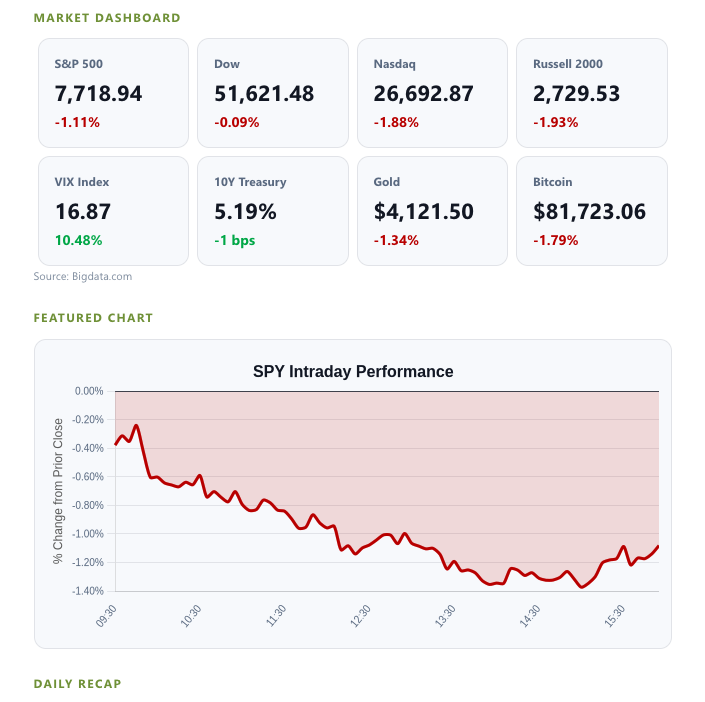
U.S. stocks finished lower with the Nasdaq leading losses after September inflation ran hotter than expected, reviving odds of another Fed hike and pressuring long‑duration tech. The dollar firmed and Treasurys sold off, while elevated oil reinforced the sticky‑inflation narrative. Bank earnings added to the crosscurrents as investors weighed margin and regulatory headwinds alongside the macro backdrop.
KEY HEADLINES & MARKET MOVERS
Inflation surprise resets the rate path: Headline CPI accelerated in September and core inflation ran a touch firmer than economists expected, a mix that pushed up policy‑rate odds and weighed on equities. Markets focused on the 0.3% monthly gain in core prices versus a 0.2% consensus, alongside an uptick in year‑over‑year readings, tilting the balance back toward a restrictive Fed stance. In response, bonds slumped and the dollar strengthened, tightening financial conditions into the close. Elevated oil—amid ongoing geopolitical tension—kept the inflation impulse front and center.
Big Tech and AI trade take the brunt: The growth complex bore the brunt of the move, with mega‑cap tech leading declines as higher discount rates met stretched AI‑led narratives. Semiconductors extended their slide, with the chip index logging a sixth straight down day as investors questioned the pace and returns on AI spending and eyed rising competitive pressure from China. A downgrade of AI‑server exposures added fuel, keeping the bid for defensives and cash‑flow certainty.
Banks in focus as earnings and regulation bite: Financials were choppy as earnings season kicked in: Bank of America’s results underwhelmed, with profit pressure tied to regulatory costs, and the stock weighed on broader sentiment intraday. The sector’s setup remains nuanced—higher rates can help net interest income, but funding costs and credit normalization are live offsets. With big banks opening the season, investors leaned defensive while the macro tone turned more hawkish.

Into tomorrow, watch whether rates stay firm and oil remains elevated—both would keep pressure on long‑duration tech and valuations—while early bank prints set the tone for margins, deposit costs, and credit. Any fresh Fed signaling in the run‑up to the next decision window will matter most for risk appetite; in this tape, guidance on the inflation trend and path of policy will likely dictate whether dips get bought or rallies fade.
Disclaimer
Duncan Williams Asset Management is an SEC registered investment adviser. SEC registration does not constitute an endorsement of Duncan Williams Asset Management by the SEC nor does it indicate that Duncan Williams Asset Management has attained a particular level of skill or ability.
This material prepared by Duncan Williams Asset Management is for informational purposes only and is accurate as of the date it was prepared. It is not intended to serve as a substitute for personalized investment advice or as a recommendation or solicitation of any particular security, strategy or investment product. Past performance is not indicative of future results. Investing involves risks, including the risk of loss of principal. Before making any investment decision, investors should consult with their financial advisor, consider their individual financial circumstances, and carefully review all relevant information and risk factors. Duncan Williams Asset Management assumes no responsibility for errors or omissions, nor does it accept liability for any loss arising from reliance on this information.
Advisory services are only offered to clients or prospective clients where Duncan Williams Asset Management and its representatives are properly licensed or exempt from licensure. No advice may be rendered by Duncan Williams Asset Management unless a client service agreement is in place.
This material is not intended to serve as personalized tax, legal and/or investment advice since the availability and effectiveness of any strategy is dependent upon your individual facts and circumstances. Duncan Williams Asset Management is not a legal or accounting firm. Please consult with your legal or tax professional regarding your specific tax situation when determining if any of the mentioned strategies are right for you.

Investment Management Group (IMG)
The Investment Management Group at Duncan Williams Asset Management is led by a team with extensive experience in investment management, financial planning, and client service. President David Scully, CFA®, CFP®, has more than 20 years of experience and is active in Memphis civic organizations. Chief Investment Officer Kyle Gowen, CFA®, CFP®, oversees investment strategy and is engaged with the local community. Investment Analyst Jack Eason, CFA®, provides research and supports charitable initiatives. The IMG team is committed to professional standards, client service, and community involvement. No statement is intended as an offer of investment advice or a guarantee of future results.


Recent Articles



Let's talk about your future.
Connect with a local Duncan Williams Asset Management advisor

5350 Poplar Ave.
Suite 600
Memphis, TN 38119

