

Revisiting Your Investment Policy Statement Before You React to Market Swings
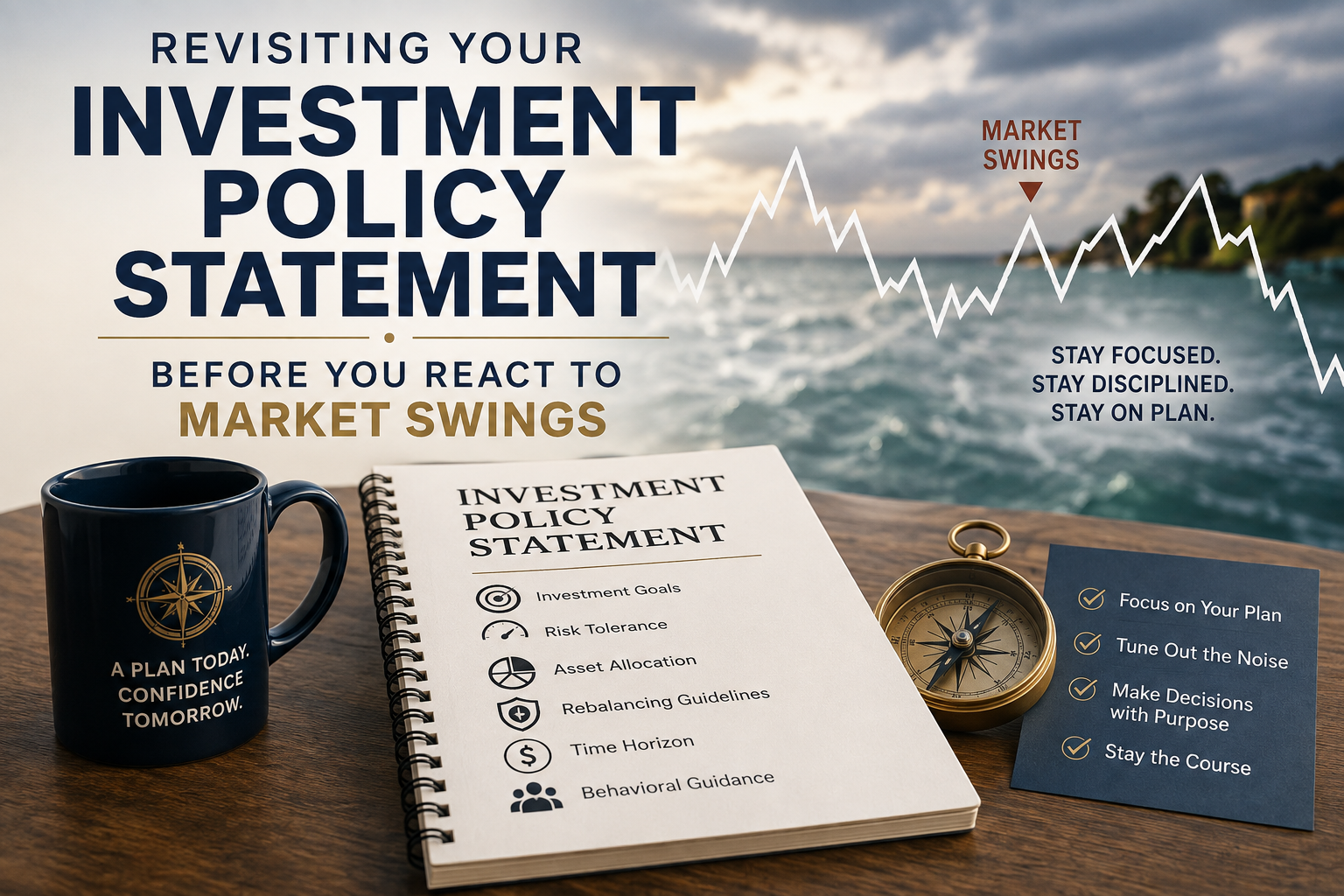
In the world of finance, as in politics, the impulse to react is often the most dangerous. A sudden tremor in the market—a drop, a spike—can rattle even the most methodically constructed 401(k) plan, making action seem not only prudent but necessary. Yet, as Robert Moses understood the power of process, so too must the prudent committee or business owner pause. The Investment Policy Statement—if one exists—stands not as a shield against uncertainty, nor as a prescient oracle, but as a bulwark of governance. It is the architecture that disciplines the passions of the moment, forcing deliberation where there might otherwise be only reaction.
What the committee is overseeing
The Investment Policy Statement, in its details and in its silences, reveals how the plan is to be governed. Its language—sometimes precise, sometimes ambiguous—lays out the roles of the committee, the criteria by which investments are to be monitored, the rhythm of meetings, the practice of placing assets on a watchlist, the requirements of documentation. In moments of volatility, these provisions do not merely guide; they serve as the line separating the ordinary noise of markets from the signals that merit further, more painstaking inquiry.
The committee’s mandate, as defined by the architecture of the governing documents, stops short of the individual; it is the blueprint and the boundaries of the plan itself that are their concern. The documents and regular reports—these are the common texts, the shared record, the armature upon which judgment is to be built. By returning to them, the committee can sift the facts that matter from those that are merely urgent, keeping deliberation within the limits of their charge and resisting the seductive simplicity of the prevailing market narrative.
Build the review around relevant facts.
A focused review, like a great investigative project, begins with the basics: does the committee possess the current version of the IPS, and do they understand its lineage—how it connects to the plan document, how it stands in relation to the committee charter? The details are not trivial: who holds authority, what reports are to be produced and read, how items are placed on—then perhaps removed from—the watchlist. Any divergence between what is written and what is practiced is not merely a technical note; it is a clue, a fissure to be explored in the ongoing task of governance.
A useful review does not require the committee to conclude as soon as a question is raised. Members can identify what is known, what is missing, and which provider or qualified professional is best positioned to supply context. This creates a record of thoughtful inquiry and gives the group a clearer basis for any later decision, rather than relying on assumptions or discrete data.
Consider the trade-offs before concluding.
Indicators, like the yellow lights on Robert Moses's traffic signals, are not commands but cautions. The appearance of a fund on the watchlist does not dictate its removal; it is instead an invitation to ask harder questions—about fees, about strategy, about the very organization and service that brought it there. In periods of tumult, the committee is called upon to remember the time horizon set forth in the policy, to weigh every criterion, and not to mistake a single dramatic outcome for the whole story.
The purpose is not the manufacture of a foregone conclusion. It is, rather, to weigh the evidence—patiently, methodically—in accordance with the processes the plan has established, and in a measure commensurate with the magnitude of the question at hand. The committee may find, as great decision-makers have found, that more information is needed, that time is the missing ingredient, that vigilance is the only prudent course for the moment—so long as the rationale is recorded, the process transparent, and the chain of responsibility unbroken.
Coordinate responsibilities and document follow-through.
The IPS becomes more useful when it appears in the ordinary workflow. Agendas can reference relevant sections, provider reports can be organized around agreed criteria, and minutes can identify the framework used. If the document is hard to use, the committee can ask counsel, its advisor, or another qualified professional whether a formal review is appropriate.
In the machinery of governance, continuity is forged through written roles and rigorous follow-up
. When a committee assigns ownership, sets deadlines, and commits to preserving records, responsibilities become visible, almost tangible. This creates a chain of custody for decisions—a record that endures through changes in
committee membership, and that allows those who come after to reconstruct the why and the how of past deliberations, to see not just the outcome, but the process that produced it.
Questions to keep on the agenda
The committee can also ask whether the policy says enough about practical accountability. A policy that describes monitoring but does not identify who receives reports, when items return to the agenda, or how decisions are preserved may need process support. The response need not be an immediate rewrite. It may begin with a gap list, a provider conversation, and advice from appropriate professionals about whether formal changes are warranted.
A sound review of the plan’s investment oversight framework usually benefits from a shared set of materials and a clear distinction between information, judgment, and implementation. Information may come from monitoring reports, provider notices, committee records, or plan documents. Judgment is the committee’s consideration of that information under its established responsibilities. Implementation concerns who will complete a follow-up, what communication or administrative work may be required, and when the committee expects confirmation. Keeping these pieces, separate can make the discussion easier to follow and the minutes more useful.
Committee members can also ask whether the information they receive is sufficient for the decision before them. A concise report that identifies a change, its context, the potential plan impact, and outstanding questions is often more useful than a large packet without a clear purpose. If more information is needed, the committee can request it and defer a conclusion until a later meeting. Deferral is not a failure when it is accompanied by a defined question, a responsible owner, and a return date.
This approach supports continuity. When a new committee member, HR leader, or provider reviews the file later, they can see what prompted the discussion and how the group moved from information to follow-through. It additionally reinforces an important boundary: plan sponsors oversee the plan’s framework and processes, while individuals make their own account decisions within the plan’s available resources. In this way, regular review supports both responsibility and a more orderly committee experience when questions surface unexpectedly. It gives the committee a repeatable method for separating a question that needs action from one that needs context.
A practical process for the committee
- 1. Collect the current IPS, plan document, committee charter, recent minutes, and latest monitoring materials in a single, version-labeled packet.
- 2. Review provisions covering duties, decision authority, monitoring criteria, and documentation. List terms that do not match present practice or reports.
- 3. Separate market-related questions from policy-related questions and request the information the existing process calls for before concluding.
- 4. Assign a follow-up owner for any gap and preserve the materials showing that the review occurred.
Building a durable governance habit
Revisiting an IPS does not require a plan to act every time markets move. It can reaffirm the framework the committee intends to follow. Returning to the policy before reacting can make governance more deliberate and create a clearer record of how plan decisions are considered over time.
Want help walking through your investment policy statement before reacting to market swings?
DWAM can help you organize the review, clarify the questions to ask your service providers, and determine areas where additional professional input may be useful. Duncan Williams Asset Management can help you walk through your plan’s investment oversight framework, understand the questions to ask your service providers, and recognize areas where additional professional input may be useful. To discuss your plan’s investment oversight framework, call our team at (901) 435-4250 to arrange a conversation about your retirement plan.
Sources & further reading
- • U.S. Department of Labor — Fiduciary Responsibilities: https://www.dol.gov/general/topic/retirement/fiduciaryresp
- • U.S. Department of Labor — Fulfilling Your Fiduciary Responsibilities booklet: https://www.dol.gov/sites/dolgov/files/EBSA/about-ebsa/our-activities/resource-center/publications/meeting-your-fiduciary-responsibilities-booklet-2021.pdf
- • U.S. Department of Labor — Retirement Responsibilities for Employers: https://www.dol.gov/agencies/ebsa/employers-and-advisers/small-business-owners/understanding-your-responsibilities
- • Fidelity Plan Sponsor Library — Investment Policy Statement Considerations: https://sponsor.fidelity.com/pspublic/pca/psw/public/library/manageplans/invest_policy_considerations.html
- • Internal Revenue Service — A Plan Sponsor’s Responsibilities: https://www.irs.gov/retirement-plans/plan-sponsor/a-plan-sponsors-responsibilities


Recent Articles


Let's talk about your future.
Connect with a local Duncan Williams Asset Management advisor

5350 Poplar Ave.
Suite 600
Memphis, TN 38119

