

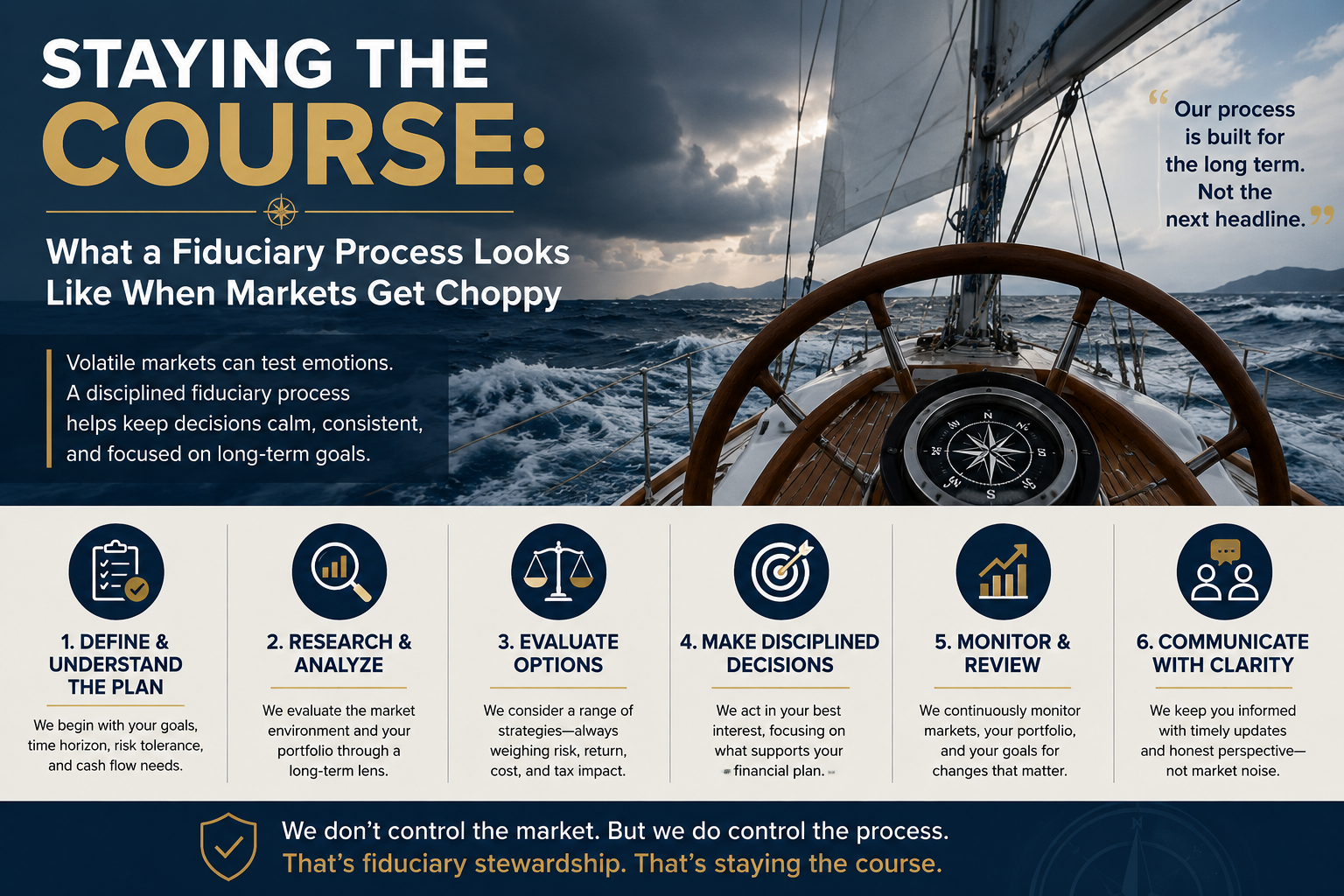
Staying the Course: What a Fiduciary Process Looks Like When Markets Get Choppy
In moments when the market heaves—when headlines, like the tides, surge and recede, and when the numbers on quarterly reports seem to shift from one extreme to another—the instinct for urgency intensifies. For the business owner, for the plan sponsor, this pressure does not simply arrive in the form of abstract numbers: it comes in the voices of employees, anxious and uncertain, and in the inescapable presence of news, each story suggesting that inaction is itself a form of risk. But genuine fiduciary care, as history and experience have shown, is not the work of augury. It is the slow, methodical construction of process—repeatable, documented, and tested—especially at the very moment when the temptation to react quickly feels most acute.
What the committee is overseeing
To understand a fiduciary process is to understand, fundamentally, that it is not a matter of prediction. The committee, gathered around a table often battered by the years and by the weight of decisions past, is charged with more than simply reacting. Its mandate is to know the plan’s purpose intimately, to follow the governing documents as one follows a map through uncertain terrain, to scrutinize every provider appointed to serve, and to measure the investment lineup against criteria set not in haste, but with deliberation. A decline in the market—a rally—these are facts, yes, but they are not by themselves the evidence that compels change. They are the weather, not the architecture.
The committee, by design, is entrusted not with the fortunes of individual accounts, but with the scaffolding that supports them all—the plan-level framework. In this, the governing documents become not just paperwork, but a shared language, a touchstone that allows the committee to separate the signal from the noise. Regular reports, routine as they may seem, are in fact how the committee re-centers itself on its true responsibilities. This discipline is what prevents the general, often breathless, narrative of the market from overwhelming the more measured, reasoned cadence of committee oversight.
Build the review around relevant facts.
A committee, confronted by the din of external events, begins not with speculation but with a question rooted in its own process: What does our established review require? Has an issue arisen that strikes at the heart of this plan—not the market at large, but this plan, this group of people? The answers emerge not from supposition, but from the careful comparison of present reports with the investment policy statement, with minutes from earlier meetings, with the steady tick of the monitoring calendar. This is the discipline that turns attention away from the world’s headlines and back to the responsibilities the sponsor is uniquely empowered to oversee.
A review, if it is to be worthy of the name, does not demand haste. The committee, patient as a grand jury, takes stock: What do we know? What is missing? Who—of all the providers, all the professionals—can bring the necessary context to bear? In this way, the record becomes more than a formality; it becomes a living document of inquiry, a foundation for decisions yet to come—decisions fortified by evidence, not by assumption or the scattered fragments of disconnected data.
Consider the trade-offs before concluding.
Yet to continue according to process does not mean to turn a blind eye to new facts. When a provider’s failure, a disruption in operations, or a seismic change in an investment option appears, these may well justify scrutiny—focused, immediate, and thorough. Here, the essential distinction is made: Is this a fact that cuts to the core of this plan, or is it merely another tremor in the wider market, already absorbed and reflected in the routine machinery of monitoring? The committee’s true task is to know the difference.
The committee’s purpose, in the end, is not to contrive an answer in advance. It is to weigh, to measure, to deliberate—always in a fashion consistent with the plan’s process, always in proportion to the moment’s demands. Sometimes this means seeking more information, sometimes postponing final judgment, sometimes keeping a watchful eye trained on developments that unfold over time. What matters is that the discussion is anchored in clarity, and that follow-through is not left to chance but made an explicit part of the record.
Coordinate responsibilities and document follow-through.
When employees, uncertain and sometimes uneasy, come forward with their questions, the committee responds not with speculation, but with clarity—plan-level information, pointers to education resources, a list of contacts for administrative support. In this, sponsors fulfill their duty to be responsive but steadfastly avoid the peril of giving individualized investment advice. And always, the minutes tell the story: communications considered, resources offered, the committee’s boundaries observed.
It is in the details—written roles, explicit follow-ups—that conversation is transformed into governance. When a committee names who will own a task, set a timeline, and determines the records to preserve, accountability ceases to be abstract. Provider responsibilities become visible, continuity is maintained, and when, as inevitably happens, membership changes or the past must be revisited, the story is there in the record: what happened, who acted, and why.
Questions to keep on the agenda
There are questions, always, that ought never to leave the committee’s agenda: Are the regular reports complete? Has a provider brought forward a development that matters, truly, to this plan? Has some past action item, once minor, grown in importance? And does every change in the meeting materials come with the context—the story—of how and why it occurred? This is not the work of trying to divine the market’s next move. It is the work of ensuring that, when the spotlight burns brightest, the machinery of governance is not found wanting.
A review that stands the test of time is one that draws a clear boundary between its elements: Information—facts, figures, reports, notices—must be distinguished from Judgment, the committee’s reasoned weighing of those facts under its mandate. Implementation, meanwhile, is the work of translating decision into action: Who will do what, when, and how will confirmation be recorded? This architecture—information, judgment, implementation—brings order to a process that might otherwise dissolve into confusion, and it leaves a record that can guide those who come after.
Committee members have the duty—and the right—to ask: Is the information before us enough to decide? Often, a concise report, one that spells out the change, its context, the possible impact on the plan, and the questions that remain, is worth more than a thick packet that obscures rather than illuminates. Sometimes, the answer will be: Not yet. More information is needed. Deferral, in this context, is not a mark of indecision, but of rigor—provided it comes with a clear question, an assigned owner, and a date for return.
In this way, continuity is not left to chance. When a new member joins, or a new HR leader or provider leafs through the files, they see not just what was done, but why: the problem posed, the evidence gathered, the steps taken, the decision made—or postponed. The record itself draws the line: sponsors are stewards of process and structure; participants are the architects of their own accounts. Regular review, then, is not just habit, but the committee’s bulwark against disorder, a method for distinguishing questions that demand action from those that simply require understanding.
A practical process for the committee
- 1. Put the regular review calendar in front of the committee and verify the next meeting date, the responsible people, and the reports that will be available.
- 2. Compare the concern with the plan document, investment policy statement, and recent minutes. Note which established review item is implicated.
- 3. Request concise, factual input from the appropriate service provider on any plan-specific development and give the committee time to consider it.
- 4. Record the materials reviewed, questions asked, follow-up assigned, and rationale for the action—or no-action—decision.
Building a durable governance habit
Turbulence in the markets is not new. It is, in fact, a constant—a recurring challenge that has tested committees for generations. Those that endure do so not by seeking refuge in drama or bold pronouncements, but by returning, again, to the documents, the calendar, the discipline of monitoring. In this steady governance, there is strength—not in the promise of certainty, but in the promise of care, of a process that will outlast the storm.
Want help reviewing your fiduciary process during market swings?
DWAM can help you organize the review, clarify the questions to ask your service providers, and pinpoint areas where additional professional input may be useful. Duncan Williams Asset Management can help you walk through your plan’s governance process, understand the questions to ask your service providers, and pinpoint areas where additional professional input may be useful. To discuss your plan’s governance process, call our team at [DWAM phone number] to arrange a conversation about your retirement plan.
Sources
- • U.S. Department of Labor — Fiduciary Responsibilities: https://www.dol.gov/general/topic/retirement/fiduciaryresp
- • U.S. Department of Labor — Fulfilling Your Fiduciary Responsibilities booklet: https://www.dol.gov/sites/dolgov/files/EBSA/about-ebsa/our-activities/resource-center/publications/meeting-your-fiduciary-responsibilities-booklet-2021.pdf
- • U.S. Department of Labor — Retirement Responsibilities for Employers: https://www.dol.gov/agencies/ebsa/employers-and-advisers/small-business-owners/understanding-your-responsibilities
- • Fidelity Plan Sponsor Library — Investment Policy Statement Considerations: https://sponsor.fidelity.com/pspublic/pca/psw/public/library/manageplans/invest_policy_considerations.html
- • Internal Revenue Service — A Plan Sponsor’s Responsibilities: https://www.irs.gov/retirement-plans/plan-sponsor/a-plan-sponsors-responsibilities
Disclosure


Recent Articles


Let's talk about your future.
Connect with a local Duncan Williams Asset Management advisor

5350 Poplar Ave.
Suite 600
Memphis, TN 38119

