

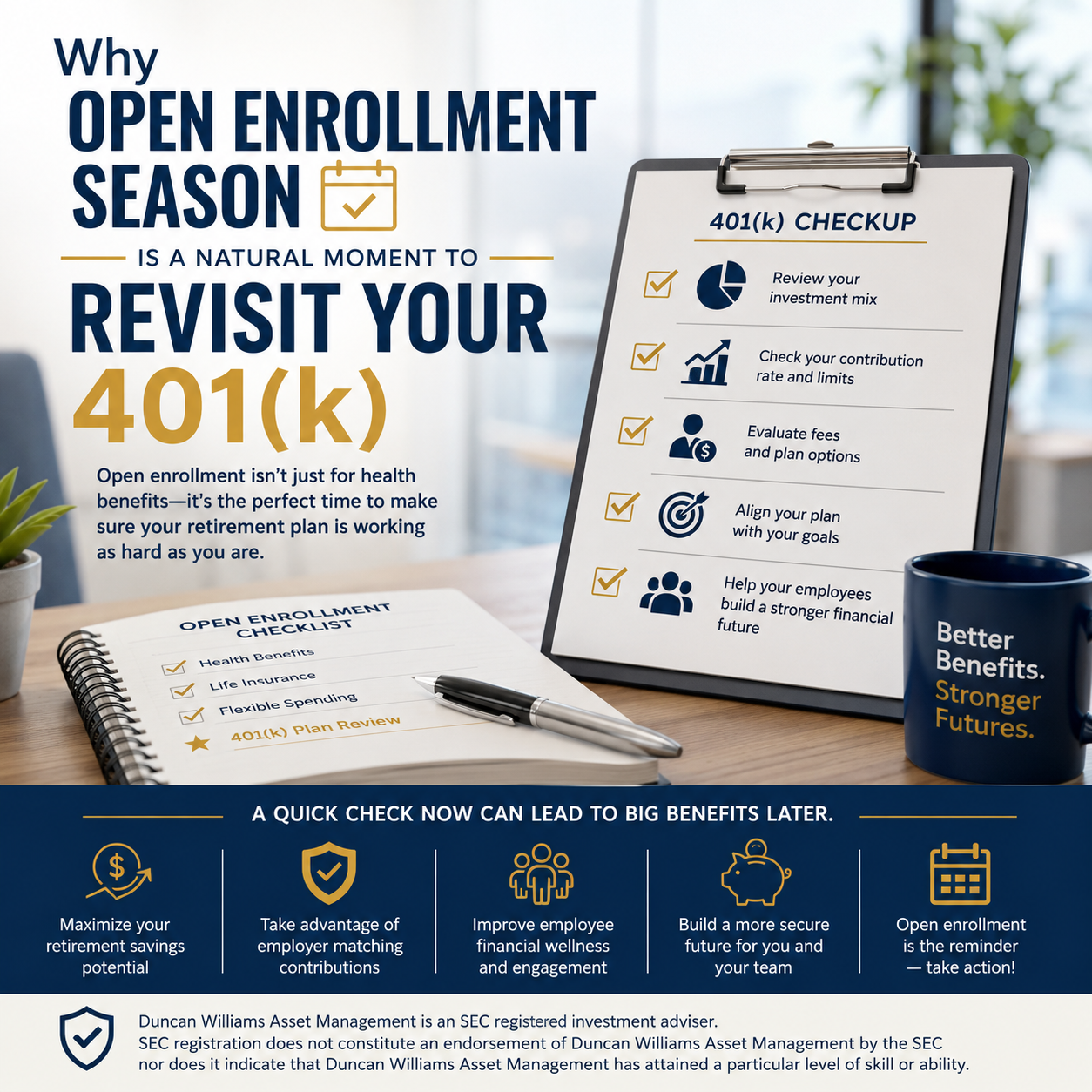
Open enrollment often concentrates attention on health coverage, payroll elections, and the employer’s overall benefits package. For a business owner or plan sponsor, it can also be a useful annual checkpoint for the company 401(k). The goal is not to turn every benefits conversation into a plan redesign. It is to use a period when internal teams, payroll contacts, and service providers are already coordinating as an opportunity to confirm that retirement-plan operations, communications, and governance are aligned for the year ahead.
Benefits season brings the right people to the table.
A 401(k) plan touches several functions in a business. Payroll applies deferral elections and contribution formulas. Human resources explains benefits and processes eligibility changes. Finance budgets employer contributions and reviews invoices. The plan’s recordkeeper, third-party administrator, and advisor may each have information or due dates that affect the sponsor’s decisions. During much of the year, those conversations can happen separately.
Open enrollment creates a natural reason to bring those viewpoints together. A brief planning discussion can surface practical questions: Are eligibility and entry-date rules being communicated consistently? Will payroll codes accommodate next year’s contribution elections? Does the benefits calendar give enough time for required notices? Have changes in the workforce or corporate structure created new administrative considerations? Asking early is often more manageable than attempting to resolve an issue once payroll files or annual testing are already underway.
A plan review is broader than investment monitoring.
Plan sponsors may associate a 401(k) review primarily with investment-menu oversight. That remains an important governance responsibility, but a useful annual review has a wider scope. It can include the plan document, operational procedures, contribution handling, fee and service-provider information, participant communications, cybersecurity practices, and records retention. The appropriate scope will vary by plan size, design, and available internal resources.
This broader framing helps a sponsor separate strategic questions from routine administration. A strategic question might be whether the plan design still fits the company’s total-rewards objectives for the coming year. A routine question might be who verifies that a new hire has met the plan’s eligibility conditions. Both matter, but they may have different owners and timelines. A simple inventory of topics and responsible parties can make the review more productive.
Use the calendar without forcing a decision.
Benefits season may reveal areas worth evaluating, but discovery does not require an immediate change. Some design changes require advance notice, document updates, payroll configuration, or consultation with tax and legal professionals. Other matters may call for clearer internal procedures or a subsequent item at the next fiduciary meeting.
A helpful distinction is between decisions for the next plan year and observations to monitor. For example, a sponsor might identify a need to revisit a match formula, eligibility rule, or notice workflow, then ask service providers about timing and implications before deciding. Separately, the sponsor may note that year-round education materials are not reaching all worksites and assign someone to improve distribution practices. Recording both types of observations preserves the value of the discussion without turning a seasonal review into a rushed commitment.
Questions that keep the review focused.
An effective meeting does not need to cover every possible retirement topic. It can begin with a small set of questions customized to the plan. Has the company had hiring growth, acquisitions, new locations, or payroll changes that affect administration? Are upcoming compensation, benefits, or workforce policies likely to affect employee qualification or contributions? Do internal teams understand which notices and deadlines apply? Are service-provider contacts, access controls, and escalation routes up to date?
It can also be helpful to ask whether the company’s benefits communications present the 401(k) in a way that is accurate and easy to find. A retirement plan can be an important part of total rewards, but messaging should be reviewed for consistency with the plan document and provider materials. Sponsors should avoid assuring outcomes or characterizing general educational content as individualized guidance.
A practical open-enrollment plan review process
1. Set a short cross-functional agenda. Include the people responsible for human resources, payroll, finance, and plan oversight, along with relevant service providers as appropriate. Identify the questions requiring answers before next year’s benefits materials and payroll configuration are finalized.
2. Compare the benefits calendar with the plan calendar. Map enrollment communications, payroll deadlines, annual notices, testing preparation, employer-contribution decisions, and filing milestones. This can reveal sequencing problems before they become time-sensitive.
3. Review plan operations against the written terms. Ask the administrator or qualified plan professional to help identify whether eligibility, enrollment, contributions, and other recurring processes are being carried out in accordance with the governing documents.
4. Record decisions, owners, and follow-up dates. Meeting notes should distinguish completed items from questions requiring further review. A concise action list gives the sponsor an audit trail and a way to revisit remaining items.
5. Carry forward a governance calendar. Turn the discussion into a repeatable annual practice, rather than relying on memory when the next benefits season arrives.
Open enrollment is most valuable as a planning rhythm, not as a one-time compliance exercise. When sponsors use it to connect benefits administration with retirement-plan governance, they can create clearer handoffs, better documentation, and more deliberate decisions over time. That habit supports a plan that is easier to administer and easier for the business to oversee as circumstances change.
Want help reviewing how your 401(k) fits into open enrollment planning?
Duncan Williams Asset Management can help you walk through your plan’s annual review process, understand the questions to ask your service providers, and recognize areas where additional professional input may be useful. To discuss your plan’s open-enrollment coordination, call our team at 901.435.4250 to arrange a conversation about your retirement plan.
Sources & further reading
• Internal Revenue Service — A Plan Sponsor’s Responsibilities: https://www.irs.gov/retirement-plans/plan-sponsor/a-plan-sponsors-responsibilities
• Internal Revenue Service — 401(k) Plan Overview: https://www.irs.gov/retirement-plans/plan-sponsor/401k-plan-overview
• Internal Revenue Service — Maintaining Your Retirement Plan Records: https://www.irs.gov/retirement-plans/maintaining-your-retirement-plan-records
• U.S. Department of Labor — Retirement Responsibilities for Employers: https://www.dol.gov/agencies/ebsa/employers-and-advisers/small-business-owners/understanding-your-responsibilities
Disclosure
This material is provided for educational and informational purposes only and does not constitute investment, tax, or legal advice. It is not intended to be, and should not be construed as, a recommendation to adopt any specific plan design, investment, or strategy. The information here is general in nature and may not reflect the current rules or guidance applicable to your specific situation. Business owners and plan sponsors should consult with their own qualified tax advisors, legal counsel, and retirement plan professionals before making any decisions related to their 401(k) or other retirement plans.


Recent Articles
%20safe%20harbor%20planning%20guide.png)

Let's talk about your future.
Connect with a local Duncan Williams Asset Management advisor

5350 Poplar Ave.
Suite 600
Memphis, TN 38119

