

Risk-Off Mood Deepens as Credit Fears and Geopolitics Weigh on Stocks

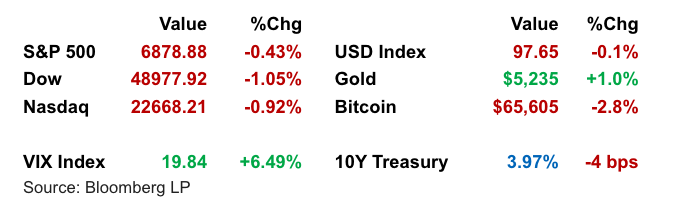
Stocks closed lower Friday, capping a volatile and mostly negative February as investors grappled with hotter-than-expected wholesale inflation, rising geopolitical tensions in the Middle East, and renewed anxiety around private credit and AI-driven disruption. Treasuries rallied into month-end, oil surged on supply concerns, gold hit fresh highs, and crypto assets sold off as traders rotated toward safety. Despite the turbulence, the broader equity pullback remained relatively contained, underscoring a market still searching for direction rather than signaling a decisive break lower.
Key Headlines & Market Movers:
Hot Producer Price Data Clouds Inflation Outlook: January producer prices rose more than expected, reinforcing concerns that inflation pressures remain sticky and complicating the Federal Reserve’s path toward easing. While bond yields ultimately fell as investors sought safety, the data added to equity volatility, particularly in rate-sensitive and cyclical sectors, as markets recalibrated expectations for policy patience.
Private Credit and AI Bubble Concerns Resurface: Unease spread through financials and tech-linked names as stress in private credit drew attention following markdowns and dividend cuts at funds tied to firms including Apollo Global Management and BlackRock. At the same time, OpenAI announced a massive capital raise backed by investors such as Amazon and Nvidia, reviving debate over AI valuations even as companies continue to commit significant capital to the buildout.
- Corporate Divergence Highlights Selectivity: Earnings reactions were sharp and highly idiosyncratic, with strength in names like Dell Technologies and Block Inc. contrasting with steep declines in firms such as CoreWeave. In media, Netflix surged after stepping aside in a bidding battle with Paramount over Warner Bros, underscoring how deal activity and capital discipline are driving stock-specific outcomes even as the broader tape softens.
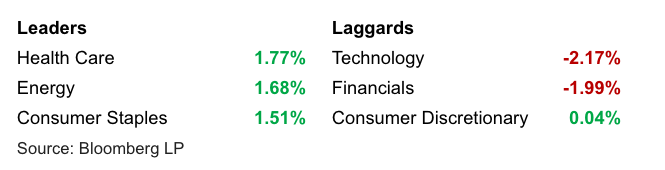
S&P 500 Sector Performance
Leaders
Looking Ahead
Investors will continue to monitor developments in the Middle East, signs of stress in private credit markets, and any follow-through from inflation data that could shift expectations for Fed policy. With equities only modestly lower for the month despite significant unease, the key question is whether tightening financial conditions and geopolitical risk evolve into something more systemic or remain episodic volatility within a still-resilient economic backdrop.
Disclaimer
Duncan Williams Asset Management is an SEC registered investment adviser. SEC registration does not constitute an endorsement of Duncan Williams Asset Management by the SEC nor does it indicate that Duncan Williams Asset Management has attained a particular level of skill or ability.
This material prepared by Duncan Williams Asset Management is for informational purposes only and is accurate as of the date it was prepared. It is not intended to serve as a substitute for personalized investment advice or as a recommendation or solicitation of any particular security, strategy or investment product. Past performance is not indicative of future results. Investing involves risks, including the risk of loss of principal. Before making any investment decision, investors should consult with their financial advisor, consider their individual financial circumstances, and carefully review all relevant information and risk factors. Duncan Williams Asset Management assumes no responsibility for errors or omissions, nor does it accept liability for any loss arising from reliance on this information.
Advisory services are only offered to clients or prospective clients where Duncan Williams Asset Management and its representatives are properly licensed or exempt from licensure. No advice may be rendered by Duncan Williams Asset Management unless a client service agreement is in place.
This material is not intended to serve as personalized tax, legal and/or investment advice since the availability and effectiveness of any strategy is dependent upon your individual facts and circumstances. Duncan Williams Asset Management is not a legal or accounting firm. Please consult with your legal or tax professional regarding your specific tax situation when determining if any of the mentioned strategies are right for you.

Investment Management Group (IMG)
The Investment Management Group at Duncan Williams Asset Management is led by a team with extensive experience in investment management, financial planning, and client service. President David Scully, CFA®, CFP®, has more than 20 years of experience and is active in Memphis civic organizations. Chief Investment Officer Kyle Gowen, CFA®, CFP®, oversees investment strategy and is engaged with the local community. Investment Analyst Jack Eason, CFA®, provides research and supports charitable initiatives. The IMG team is committed to professional standards, client service, and community involvement. No statement is intended as an offer of investment advice or a guarantee of future results.


Recent Articles
%20Review%20Before%20Q4.png)

Let's talk about your future.
Connect with a local Duncan Williams Asset Management advisor

5350 Poplar Ave.
Suite 600
Memphis, TN 38119

